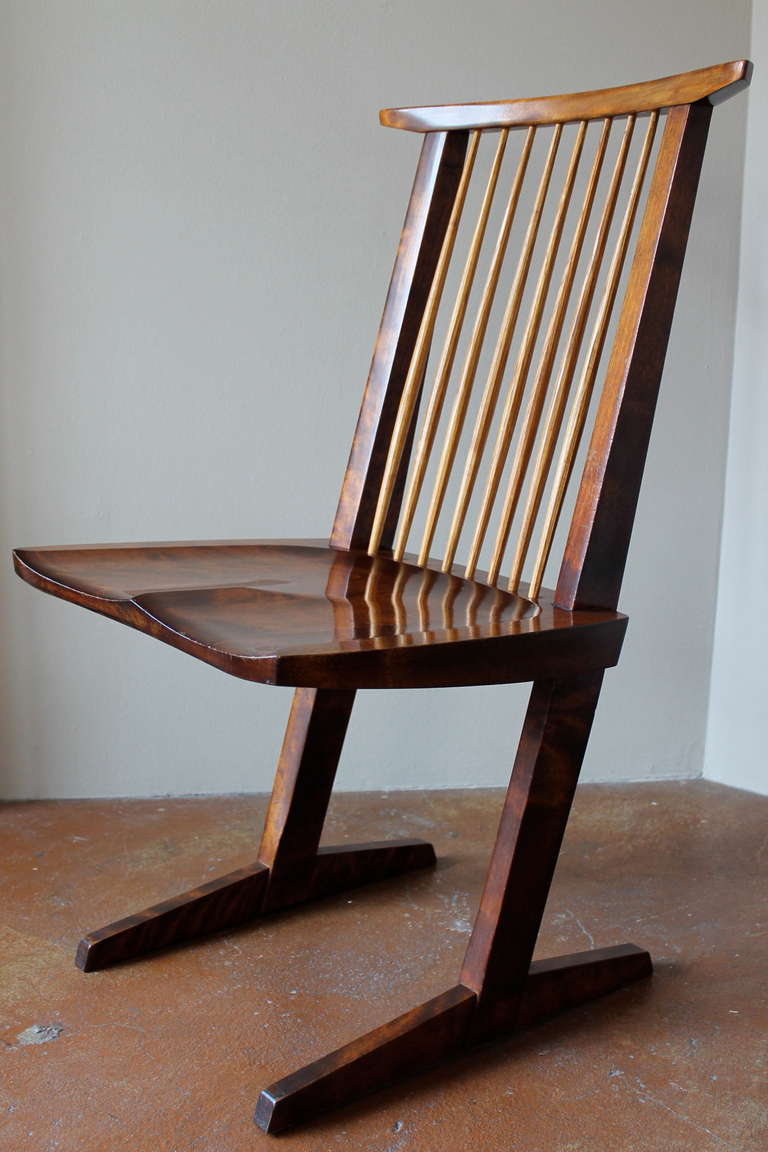
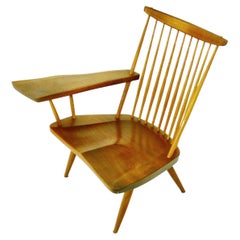
The Conoid Chair is one of George Nakashima’s signature seating designs, made in New Hope, Pennsylvania and held today by institutions including the Art Institute of Chicago, the Smithsonian American Art Museum, and The Met. Introduced in 1961, it belongs to Nakashima’s Conoid line and takes its name from the Conoid Studio, translating that building’s curved vault and outward-facing sense of space into furniture. In walnut with hickory spindles, the chair is instantly recognizable for its daring structure: the seat cantilevers from only two legs. It’s the kind of design that makes studio furniture feel architectural rather than decorative, which is exactly why collectors keep circling back to it.
Learn
What Makes the Conoid Chair a Nakashima Essential
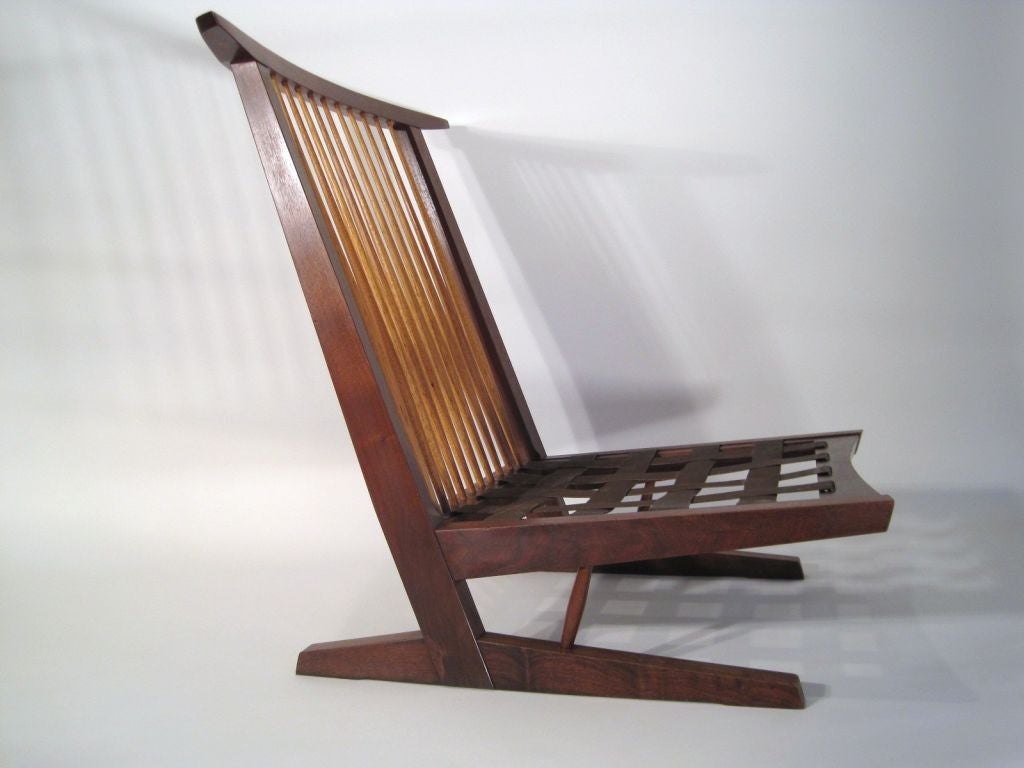
George Nakashima's Conoid Chair, introduced in 1961, is the definitive expression of his architectural thinking in furniture—a cantilevered seat supported by just two walnut legs, with hickory spindles rising to a gently arched cross-member. The design emerged directly from the Conoid Studio, a radical warped-shell concrete structure Nakashima built on his New Hope, Pennsylvania property between 1957 and 1959, which remains the only such experiment in reinforced concrete on the grounds. The chair's cantilever was a conscious departure from both the steel-tube versions of Bauhaus and the plywood laminates used by Alvar Aalto; Nakashima used solid wood, making the chair unusually heavy, so he added sled runners to allow it to slide across carpet without straining the frame. The spindles and solid seat owe a clear debt to the Windsor chair tradition, but the continuous leg-and-stile construction—the back uprights flow directly into the front legs—gives it a visual tautness that is entirely modern. It is, in essence, the Conoid Studio rendered at human scale: the soaring window wall of the building becomes the chair's airy spindle back, and the same respect for the tree's natural form that guided his studio design governs the shaping of each walnut seat plank.
 nakashimawoodworkers.comnakashimawoodworkers.com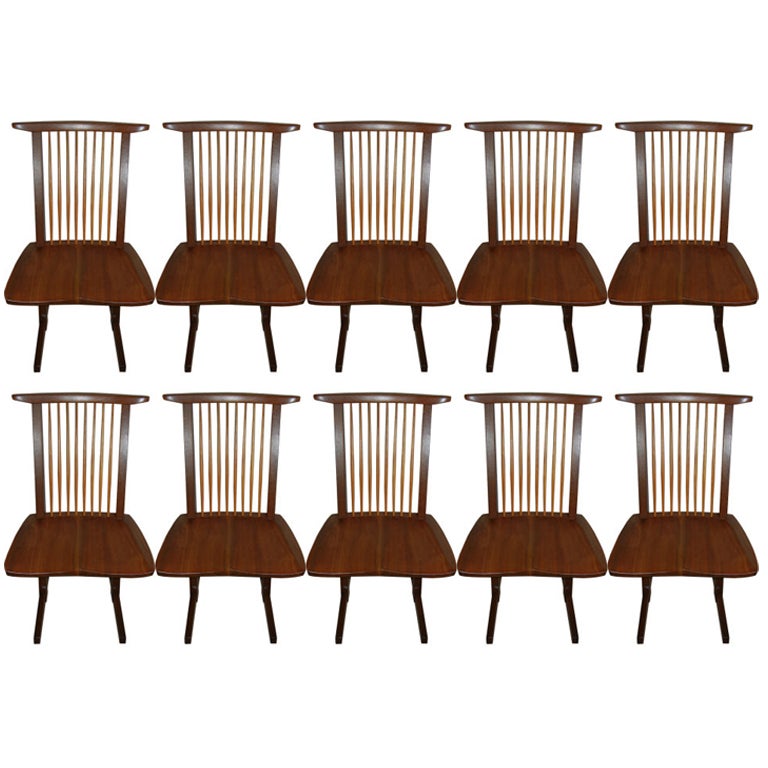
 modernegallery.commodernegallery.com
 slam.orgslam.org
+Field notes
- —The chair's name derives from the Conoid Studio (built 1957–59), Nakashima's tour de force of warped-shell concrete construction and the only such building on his New Hope property, home to his design department and client slab selection.
- —It was one of the first furniture designs to achieve a cantilever in solid wood—rather than steel tubing or bent plywood—forcing Nakashima to add integrated sled runners so the heavy chair could be moved on carpet without breaking its frame.
- —The construction uses continuous legs and stiles (the back uprights extend straight into the front legs), a detail that sets it apart from traditional spindle-backs and gives the chair its characteristic architectural tension.
- —While the chair references the colonial Windsor chair in its spindle back and solid seat, Nakashima intentionally shifted the proportion—the seat is deliberately cantilevered forward, leaving a dramatic gap between the front edge and the pair of legs.
- —The chair was first introduced in 1961 (designed circa 1960) and remained in production through the late 1980s; each example was handcrafted in American black walnut with hickory spindles (some later examples used ash), with subtle variations in seat shape and spindle taper.
- —The Smithsonian's example (1971) includes a label quoting Nakashima: 'There is drama in the opening of a log—to uncover for the first time the beauty in the bole, or trunk, of a tree hidden for centuries,' linking the chair's exposed walnut grain directly to his philosophy of giving wood a second life.
Learn
From the Conoid Studio to the Conoid Line
The Conoid line is not a vague style but a specific family of furniture designed by George Nakashima, named after the remarkable concrete-and-glass studio he built on his New Hope, Pennsylvania property between 1957 and 1959. That studio—a tour de force of warped-shell concrete construction with a soaring, south-facing glass wall—directly inspired the furniture’s defining features: bold cantilevered forms, heavy angled uprights with a narrow waist, and a deep architectural logic that marked a decisive turn in Nakashima’s work. Introduced in 1961, the line includes the celebrated Conoid Chair (a cantilevered seat supported by only two legs, a rare move in furniture), the Conoid Dining Table (whose iconic base mirrors the chair’s angle and is deliberately restrained to showcase a single massive plank top), and a series of other pieces like the wall-hung Cross-Legged Desk (later called the Conoid Desk) and a Conoid Chest originally designed as a hi-fi cabinet. Every piece combines Nakashima’s architectural training with his reverence for wood—using free edges, butterfly joints, and spectacular slabs like book-matched Persian walnut—all while the base structures echo the conoid geometry of the studio itself.


 emuseum.mfah.orgemuseum.mfah.org
 modernegallery.commodernegallery.com
+Field notes
- —The Conoid line is named after a specific building—the Conoid Studio, a reinforced-concrete warped-shell structure built from 1957 to 1959 on the Nakashima Homestead in New Hope, Pennsylvania—and the furniture was first introduced in 1961, directly translating the studio’s curved vault and lyrical outward-facing space into cantilevered and angled forms.
- —The Conoid Chair cantilevers the seat from only two legs, a structural rarity in furniture derived from Bauhaus engineering, and the whole Conoid line marked the moment Nakashima’s architectural training (MIT, class of 1930) became front and center in his work.
- —The Conoid Dining Table uses a restrained base—two heavy angled uprights lightened by a narrow waist, a single rectangular floor stretcher, and two sets of lateral feet—all designed to frame and set off a massive single-board plank top, often with a free edge and sometimes joined with rosewood butterfly joints.
- —A 1989 Conoid Dining Table in Persian walnut has a book-matched, dramatically figured top, showing how Nakashima’s Conoid bases became the sculpturally simple pedestal for the most spectacular slabs he could source.
- —The Conoid line includes less-common variants like the Wall Hung Conoid Desk (originally called the Cross-Legged Desk, 1968–69, with a single-board American black walnut top and two free edges) and a 1962 Conoid Chest made of East Indian laurel with a holly front, originally a custom one-off hi-fi cabinet for a Philadelphia family.
- —A 1960 Conoid Coffee Table in the MFAH collection sold for $140 new and synthesizes architectural cantilever technology with organic free-edge walnut, proving Nakashima was aware of mid-century Modernism even while his studio craft approach remained distinct.
Discover
Museum and Gallery Writing Worth Reading Closely
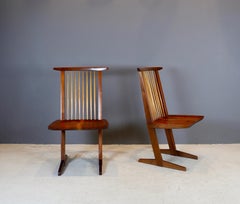

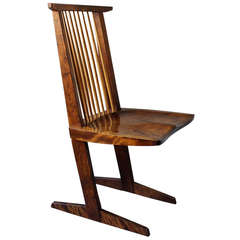
The Conoid Chair, George Nakashima's most iconic design, is a masterclass in how a single piece of furniture can embody architectural thinking, material reverence, and a deeply personal philosophy. Museum labels across the Art Institute of Chicago, the Smithsonian, the Met, and the MFA Boston each reveal a distinct layer of the chair's meaning: the Art Institute's example is inscribed with a dedication to the museum dated April 29, 1988, noting the seat is cut from one piece of walnut; the Smithsonian's label quotes Nakashima on the 'drama in the opening of a log' and explicitly links the thin hickory spindles to the window walls of his New Hope studio, itself shaped like a conic section; the Met's example is from 1971, the same year the Smithsonian's example was made; and the MFA Boston's chair, from 1979, carries the handwritten mark 'Boston Museum / FAIRBANKS' — likely a nod to the donor. Together, these public-facing texts transform the chair from a mere object into a document of the artist's intentions: the cantilevered seat on just two legs was not a formal stunt but a practical solution for mobility on carpet, and the walnut's natural edge was left exposed, letting the tree's own anatomy remain visible. The museum entries, read closely, teach you that the Conoid Chair is never just a chair — it is a record of Nakashima's belief that woodworking gives a 'second life' to a tree, and a direct translation of his studio's architecture into furniture.
+Field notes
- —The Art Institute of Chicago's 1988 Conoid Chair bears a handwritten inscription under the seat that reads 'Chicago Art Inst. / (One piece fig. seat) / George Nakashima, April 29, 1988' — a rare instance of the artist explicitly noting the single-plank construction and the piece's museum destination.
- —According to the Smithsonian American Art Museum's label, the chair's name comes directly from Nakashima's Conoid Studio in New Hope, Pennsylvania — a building shaped like the section of a cone — and the thin hickory spindles were designed to echo the studio's graceful window walls, an architectural concept translated into furniture.
- —The Smithsonian also records a key practical detail: Nakashima deliberately cantilevered the seat over only two legs so the chair could slide easily on carpet — a quiet but telling example of his fusion of sculptural form with everyday use.
- —The MFA Boston's Conoid Chair, made in 1979, has an ink inscription on the underside reading 'Boston Museum / FAIRBANKS' — likely referring to a donor or museum contact, showing that Nakashima often personalized his works with handwritten marks tied to their intended institutional home.
- —The Moderne Gallery notes that the Conoid line was introduced in 1961, inspired by the curved vault of the Conoid Studio, and that Nakashima built these chairs from American black walnut with hickory spindles, available as singles or sets — a production approach that allowed the design to be both a unique studio piece and a repeatable commission.
- —The Smithsonian's Luce Center label quotes Nakashima directly: 'It is an art and a soul-satisfying adventure to walk the forests of the world, to commune with trees, to take them when mature or even dead and… to bring this living material to the work bench, ultimately to give it a second life' — a statement that positions the Conoid Chair not as a product but as a philosophical act of renewal.
Explore
Where Collectors Actually Encounter Conoid Chairs
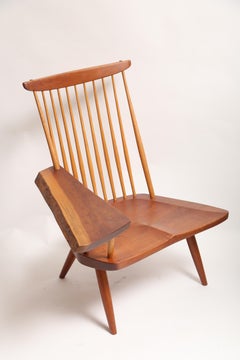
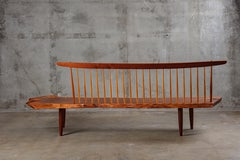
Collectors most directly encounter Conoid chairs not by stumbling upon an original piece at a flea market, but through the specialized auction catalogs that document and celebrate these objects. The Skinner 20th Century Design Auction Catalog from December 6, 2014 (Boston sale) is a prime example: its cover features a George Nakashima Conoid Bench, making it a coveted reference item in itself. Printed by Signature Printing, USA, and packed with 447 lots, this catalog represents the kind of dealer- and collector-focused ephemera where Conoid designs live on even when the chair itself is locked in a private collection. Resellers on platforms like Poshmark now offer these catalogs for around $25, often categorizing them as coffee table books, which shows how these documents have become collectible artifacts that give enthusiasts a tangible encounter with Nakashima's iconic work.
 poshmark.composhmark.com
+Field notes
- —The Skinner 20th Century Design Auction Catalog from December 6, 2014 (Boston) features a George Nakashima Conoid Bench on its cover, making it a primary artifact for encountering the design outside of a museum or private collection.
- —The catalog includes 447 lots and was printed by Signature Printing, USA, providing a detailed record of the auction market for 20th century design pieces like the Conoid Bench.
- —The Poshmark listing itself categorizes the catalog as a 'Skinner Coffee Table Book', indicating that collectors treat these auction catalogs as display-worthy collectibles in their own right.
- —The condition of the catalog—'lightly curved, light wear on covers, wear on one corner, inside pages clean'—shows how even used examples are traded for $25, reflecting their value as reference material for Nakashima enthusiasts.
Keep exploring
More of George Nakashima’s Conoid Chair
Branch out
Beyond George Nakashima’s Conoid Chair
More to explore
In the same world.
Eames Lounge Chair and Ottoman
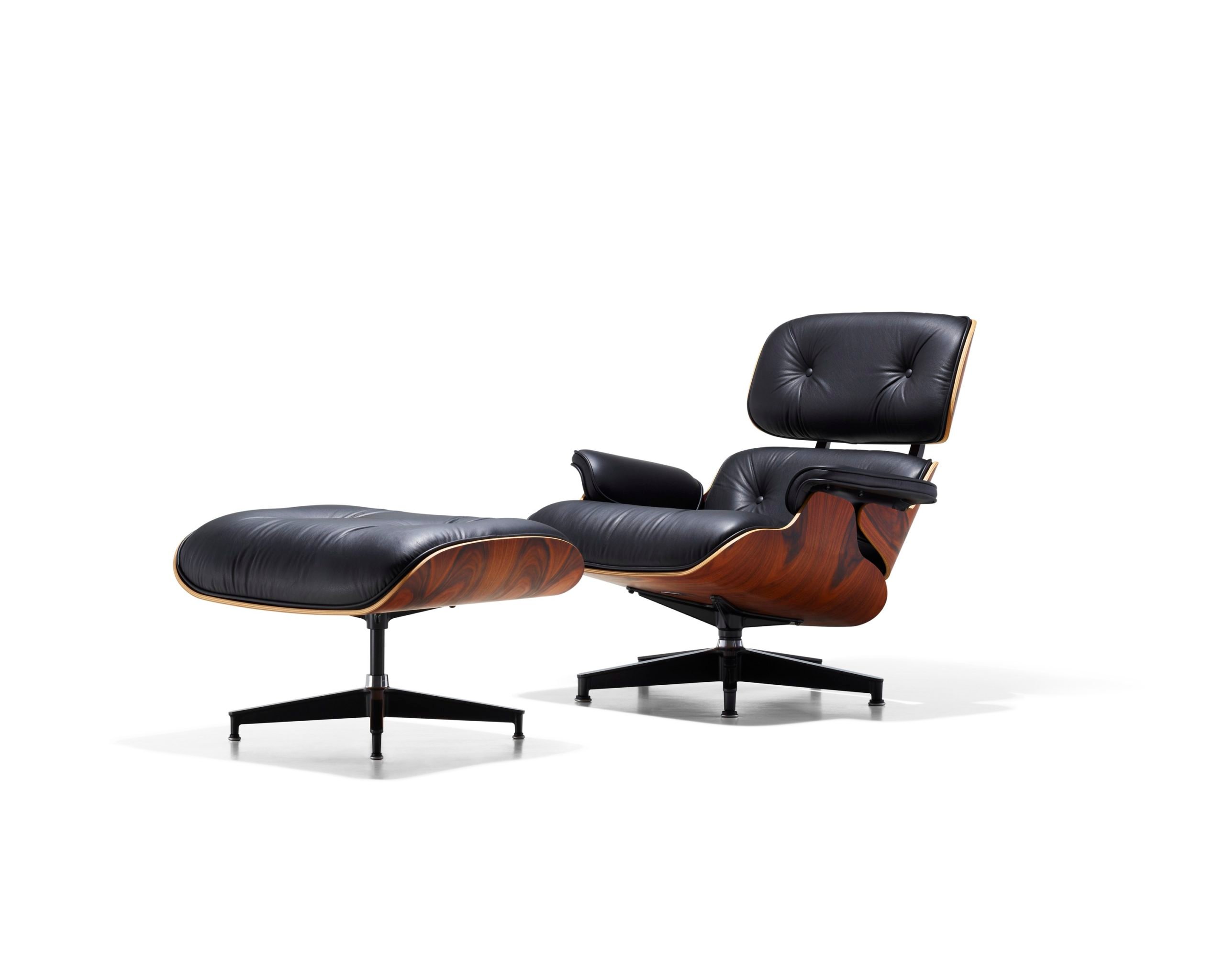
The Eames Lounge Chair and Ottoman is one of the signature objects of mid-century modern design: a 1956 Charles and Ray…

Mid-Century Modern Furniture
Mid-century modern furniture lives in two worlds at once: it is a living retail style category and a serious vintage col…
Platinum Modern Maki-e Fountain Pens
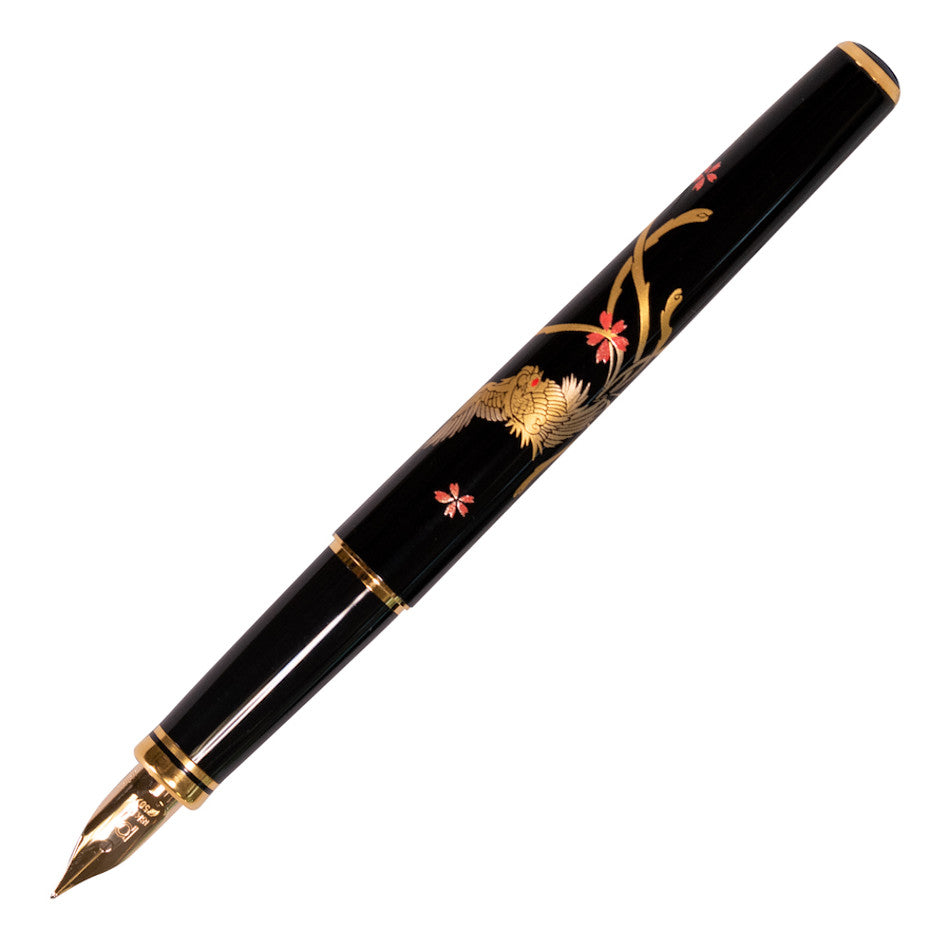
Platinum’s Modern Maki-e pens sit in a very specific corner of fountain-pen collecting: Japanese motif pens made with a…
Sailor Maki-e Fountain Pens
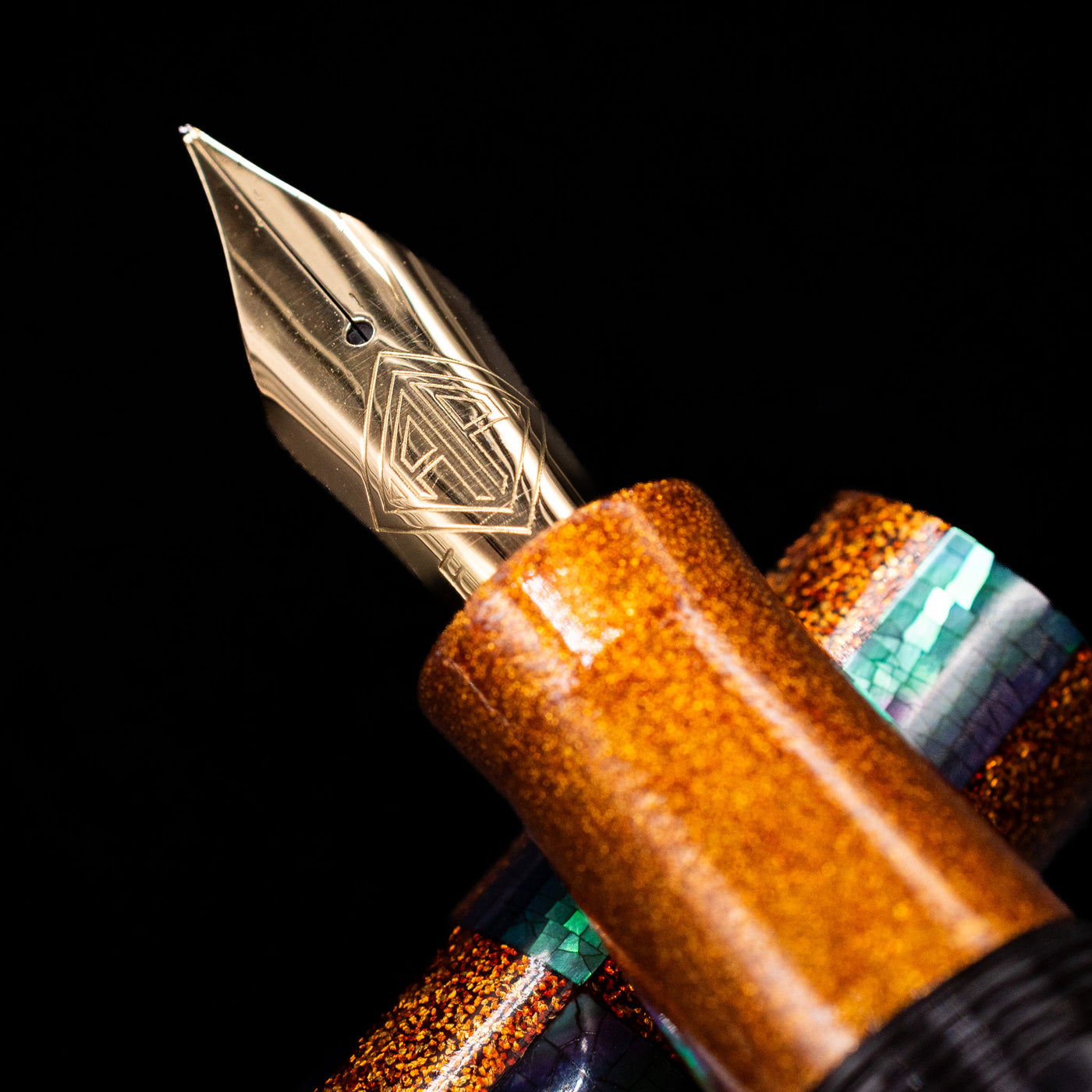
Sailor’s Maki-e fountain pens sit at the meeting point of writing instrument collecting and a Japanese decorative art wi…
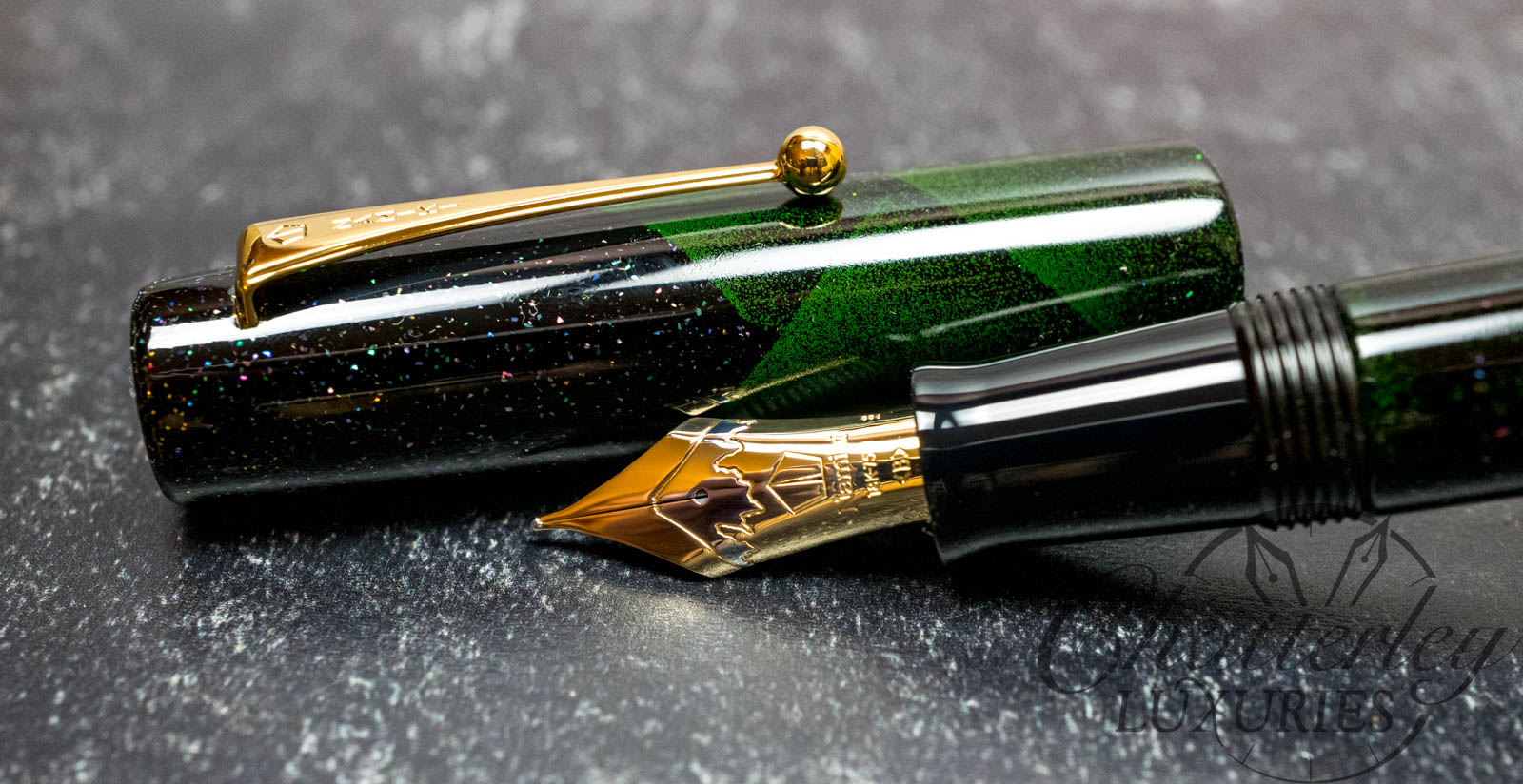
Namiki by Pilot
Namiki is Pilot’s Japanese brand for high-end fountain pens, especially models finished in maki-e and urushi lacquer. Th…
Imagery
Know someone who’d love this?
Discovered by ArcurianAuto-generated from public sources and AI synthesis — it may be incomplete or inaccurate. Treat it as a starting point for your own exploration, not professional (medical, legal, financial, or safety) advice. Verify anything you act on. Report this page.