This is the recurring public-safety pattern around box jellyfish advisories at Waikiki and nearby south shore beaches, where Honolulu Ocean Safety posts warnings after lifeguards observe jellyfish in the water. The detail locals actually watch is the lunar timing: sightings often rise about 8 to 10 days after the full moon, which is why the Waikiki Aquarium and Hawaii Ocean Safety publish monthly jellyfish calendars marked by higher-probability days. Recent advisories have covered Waikiki alongside Ala Moana, and some events have led to multiple sting responses in a single day. Once you know the warning signs, the HNL Alert rhythm, and how the calendar is meant to be used, beach conditions stop feeling random.
Learn
How Waikiki box jellyfish warnings actually work
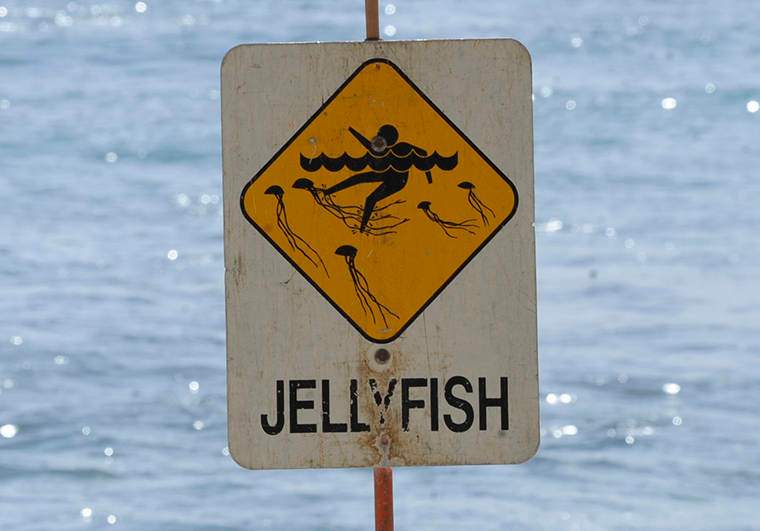
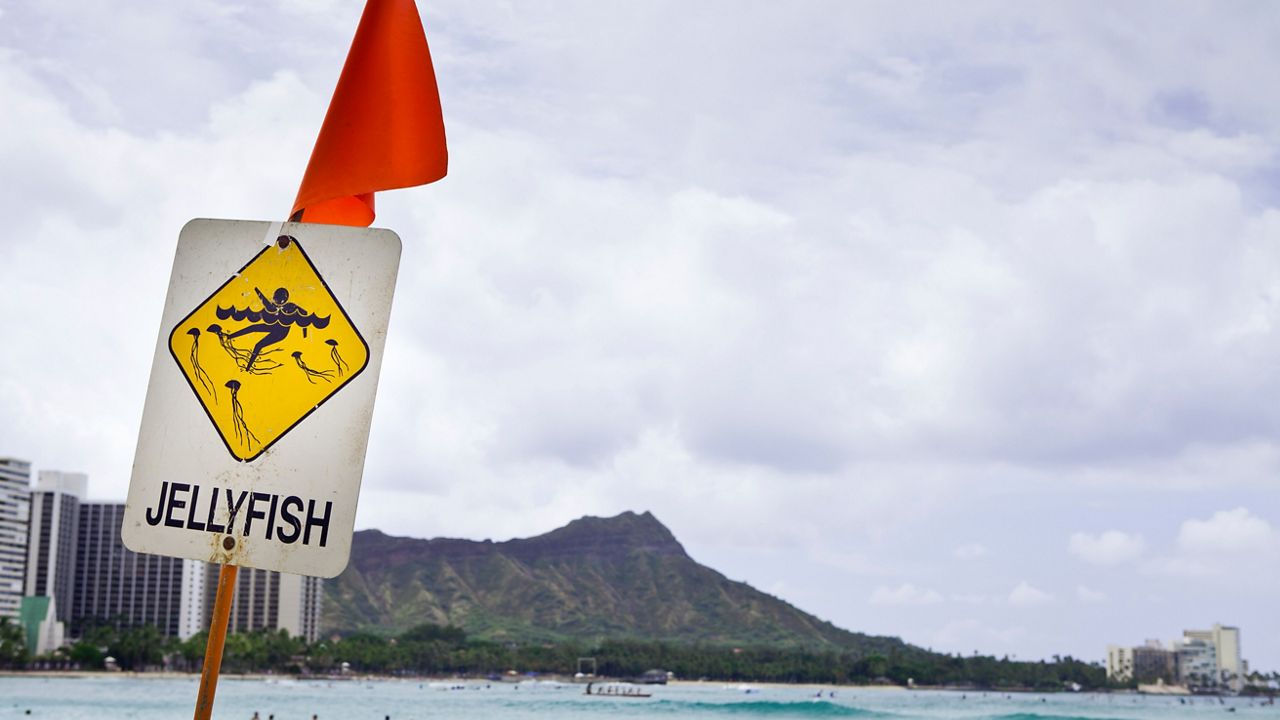
Waikiki’s box jellyfish warning system is a blend of lunar predictability, real-time lifeguard observation, and a city-wide alert network. The cycle is reliably moon-driven: box jellyfish (Carybdea alata) swarm Oahu’s south and leeward shores 9 to 10 days after each full moon, a pattern Honolulu Ocean Safety (HOS) has tracked for years. When lifeguards spot the animals on the beach or in the water—which often means multiple stings have already occurred—they post yellow warning signs and trigger an HNL Alert, a free text or email notification anyone can sign up for by texting “HNLALERT” to 888777 or visiting hnlalert.gov. The advisory typically names specific beaches like Ala Moana, Waikiki, Hanauma Bay, or Maili and stays active for a multi-day “high probability” window. Once an advisory is live, lifeguards become the primary information hub—beachgoers are told to ask a lifeguard directly for the latest conditions. Meanwhile, EMS stands ready: serious stings have required hospital transport, including a 42-year-old man taken in serious condition after being stung on a boat tour. It’s a system that leans more on boots-on-the-sand observation than on any high-tech detection, and its effectiveness depends on locals and visitors alike checking in before they hit the water.


 hawaiinewsnow.comhawaiinewsnow.com
 khon2.comkhon2.com
+Field notes
- —The timing of box jellyfish warnings is tied to a predictable lunar cycle: the animals appear 9 to 10 days after each full moon along Oahu's south and leeward shores.
- —Honolulu Ocean Safety lifeguards verify jellyfish presence on shore and in water before posting signs and issuing an advisory—they don’t rely on forecasts alone.
- —The city’s HNL Alert system is the official notification channel; anyone can subscribe by texting “HNLALERT” to 888777 or visiting hnlalert.gov.
- —During a single active advisory in January 2026, Ocean Safety responded to 13 box jellyfish-related incidents in one day, including stings on a boat tour and a canoe paddler.
- —Advisories typically remain in effect for a “high probability” window lasting several days—often from Sunday through Wednesday.
Learn
The monthly pattern: full moon to higher-probability days
The monthly box jellyfish warning pattern on Oʻahu’s south shore is one of the most reliable biological clocks in the ocean, driven by a precise trigger: a critical number of hours of darkness after sunset during the lunar cycle. Around 8 to 12 days after each full moon—specifically during the Hawaiian night called Kāloa—mature Alatina alata (also referred to as Carybdea alata in older sources) actively swim from deep offshore holding areas toward Waikīkī and other leeward beaches to spawn, not to feed or because they are passively stranded. This isn’t a vague correlation; researchers from the University of Hawaiʻi at Mānoa, including Angel Yanagihara’s lab, have spent over a decade tracking the animals with nightlong boat trips, scuba dives, side-scan sonar, and computer current models. They found that the jellies wait out most of the month in a zone about a mile straight out from the Kapahulu groin, where a circular current concentrates both them and their prey. The warning calendar issued by the Waikīkī Aquarium and used by lifeguards predicts these windows with remarkable consistency, though the actual abundance varies dramatically from year to year. A 14-year study (1998–2011) showed that inter-annual fluctuations in jellyfish numbers correlate strongly with primary production, zooplankton biomass, and the North Pacific Gyre Oscillation—meaning the moon sets the schedule, but bottom-up food-web dynamics determine how many show up.



 safetoswimhawaii.comsafetoswimhawaii.com
+Field notes
- —The trigger isn't the full moon itself but the specific nights of the lunar cycle—called Kāloa in the Hawaiian calendar—when there is a critical number of hours of darkness between twilight and moonrise, cueing mature Alatina alata to actively swim to leeward shores to spawn.
- —Between spawning events, box jellyfish concentrate about one mile straight offshore from the Kapahulu groin, held in place by a circular current that also corrals their prey, not drifting randomly in the open ocean.
- —The Waikīkī Aquarium's official box jellyfish calendar—used for the monthly warning windows—estimates arrival 8–10 days after the full moon, while the Hawaii Ocean Safety portal and other sources extend the window to 8–12 days post-full moon, with lifeguards posting purple flags during those dates.
- —A 14-year analysis (1998–2011) of 173 consecutive full-moon cycles found that box jellyfish abundance at Waikīkī lacks seasonality but oscillates dramatically between years, with strong positive links to primary production, >2 mm zooplankton biomass, and the North Pacific Gyre Oscillation (NPGO)—not just the lunar phase.
- —The 2026 calendar predicts 13 warning windows (because of a blue moon on May 31), with each window spanning roughly 4–5 days; for example, the January full moon on Jan 3 gives a warning window of Jan 11–15, and the December full moon on Dec 23 stretches into Jan 4, 2027.
Learn
Who tracks it in real time: lifeguards, alerts, and local beach reporting
When box jellyfish show up off Waikiki, the real-time tracking falls to the Honolulu Ocean Safety lifeguards — they're the ones on the sand making the call. On a typical alert day, they're out there before 8 a.m., spotting jellies both on shore and in the water, then posting warning signs and issuing an HNL Alert (the city's official notification system) that hits phones of anyone who's signed up via hnlalert.gov or by texting 'HNLALERT' to 888777. The alerts are remarkably specific — they name exact beaches like Ala Moana Beach Park, Kuhio Beach, and Hanauma Bay, and often break down incidents by location, like the eight stings reported in the Ala Moana area during a single morning in January 2026. The system isn't just about warnings; it tracks real sting counts and severity, with EMS sometimes transporting victims in serious condition (like a 42-year-old man from a boat tour) while others, like a 24-year-old on the same tour, decline hospital transport. What's surprising is how localized the data gets — one report even logged a canoe paddler stung outside Waikiki. Lifeguards are the pivot point: the alerts explicitly tell people to 'always check with a lifeguard for the latest beach and ocean conditions,' meaning the official advisory is just the headline; the granular, minute-by-minute intel comes from the tower.

+Field notes
- —The Honolulu Ocean Safety lifeguards are the primary eyes-on-the-water — they observe jellies on shore and in the water, then post physical warning signs and trigger an HNL Alert (a city-run system for severe weather, ocean conditions, and road closures).
- —HNL Alerts are the official real-time notification channel: you subscribe by visiting hnlalert.gov or texting 'HNLALERT' to 888777, and they issue specific beach-name alerts (e.g., Waikiki, Ala Moana, Maili, Hanauma Bay) with timestamps often before 9 a.m.
- —Lifeguards don't just post signs — they track the exact number of sting incidents by location; on January 11, 2026, Ocean Safety tallied 13 incidents: 8 at Ala Moana Beach area, 3 from a boat outside Kuhio Beach, and 1 from a canoe paddler outside Waikiki.
- —EMS and Ocean Safety coordinate on sting severity: victims are sorted by transport status — some are taken to the hospital in serious condition (like a 42-year-old man on a boat tour), others are treated on scene and decline transport, and families sometimes drive kids to the hospital themselves.
- —Alerts include a predictive element: Ocean Safety spokesperson Christopher Latronic noted that a given day is 'the first day of high probability Box Jellyfish and Portuguese man o' war influx for this month’s cycle,' with the threat window extending through Wednesday.
- —In emergencies, the official guidance is unambiguous: 'In an emergency call 911' — but the pre-incident check is to talk to a lifeguard, not just read the sign, because conditions change hour by hour.
Discover
Read the advisories and incident coverage


The box jellyfish advisory system in Waikiki is a tightly choreographed monthly ritual that most visitors never see coming. Triggered by the lunar calendar — these invertebrates reliably appear eight to ten days after a full moon, specifically on Oahu's south-facing shores — the alerts are issued by Honolulu Ocean Safety lifeguards who physically post warning signs at key beaches like Ala Moana Beach Park, Kuhio Beach, and Hanauma Bay Nature Preserve, and simultaneously push notifications through the city's HNL Alert system (which you can subscribe to by texting 'HNLALERT' to 888777). The incidents are surprisingly specific: on a single day in January 2026, Ocean Safety responded to 13 box jellyfish-related incidents, including three stings from a boat outside Kuhio Beach and one from a canoe paddler, with five people requiring medical assistance. What's striking is that the sting risk isn't just in the water — box jellyfish wash up on sand, and contact with any part of their bodies, alive or dead, whole or in pieces, can cause excruciating pain or even anaphylactic shock in allergic individuals. The advisory language is consistent across every report: 'Always check with a lifeguard for the latest beach and ocean conditions,' a reminder that the warning signs are just the start of a real-time safety net.
+Field notes
- —Box jellyfish stings aren't limited to swimmers — three stings came from a boat outside Kuhio Beach and one from a canoe paddler, proving that simply being on a vessel doesn't protect you from contact with tentacles in the water column.
- —The advisory follows a strict lunar rhythm: box jellyfish appear eight to ten days after a full moon on Oahu's south-facing shores, a pattern that allows lifeguards to predict high-probability windows well in advance.
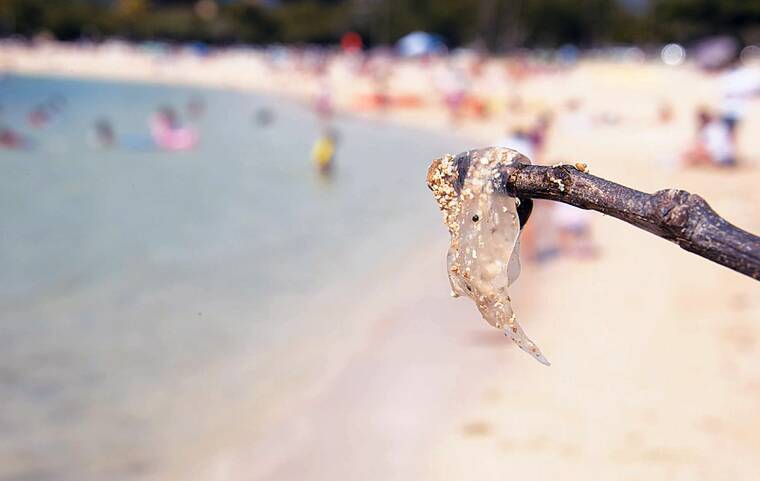
- —Even a dead or dismembered box jellyfish on the sand is a threat — contact with any part of its body, 'whether alive or dead, whole or in pieces,' can trigger anaphylactic shock in allergic individuals.
- —The city pushes alerts through HNL Alert, a free notification system you can join by texting 'HNLALERT' to 888777 or visiting hnlalert.gov — it covers severe weather, road closures, and ocean conditions, not just jellyfish.
- —On a single day in January 2026, Honolulu Ocean Safety logged 13 box jellyfish incidents across Ala Moana, Kuhio Beach, and Waikiki, with five people transferred to EMS — and the advisory warned the threat would last three days starting from the first day of the monthly influx.
Explore
Use the calendar correctly before you swim
The Waikīkī box jellyfish calendar, maintained by the Waikīkī Aquarium, is a predictive tool based on the lunar-timed spawning cycle of the Hawaiian box jellyfish (Alatina alata). It estimates windows 8–12 days after each full moon when jellyfish are most likely to appear on south-facing Oʻahu beaches, but it is not a guarantee—jellyfish can arrive any day. To swim safely, treat the calendar as a forecast, not a green light: always check posted warning signs, look for purple flags, and ask a lifeguard about current conditions before entering the water. The 2026 calendar includes 13 full moons (including a blue moon on May 31), meaning 13 predicted warning windows.

 hawaii-guide.comhawaii-guide.com
 to-hawaii.comto-hawaii.com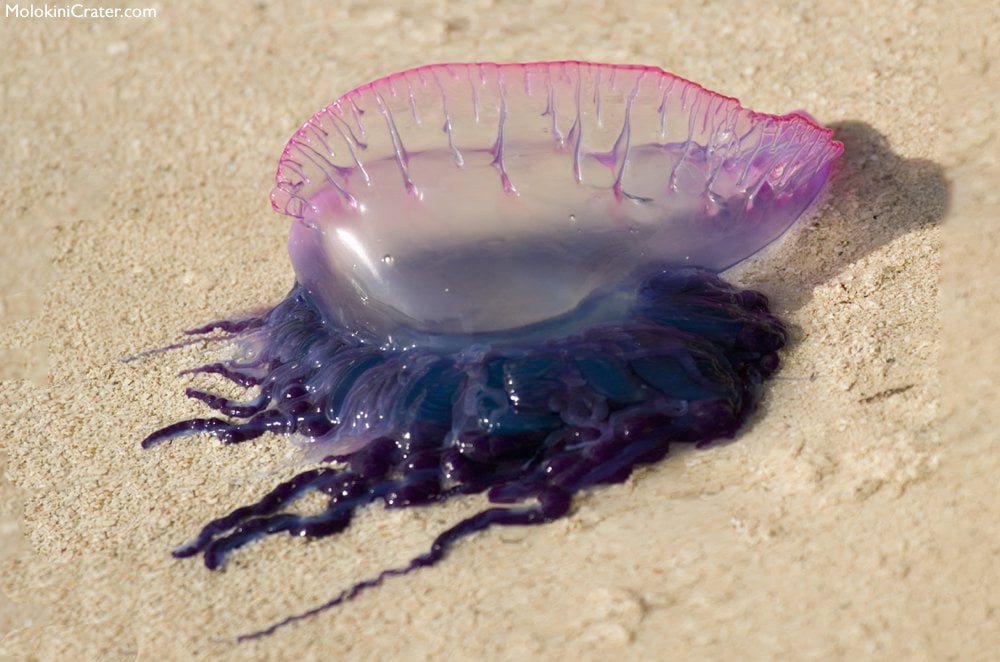
+Field notes
- —The official Waikīkī Aquarium box jellyfish calendar is based on 8–10 days after the full moon, but the arrival window is often cited as 8–12 days; the calendar explicitly states it is for informational purposes only and that jellyfish may be present on any day.
- —The Hawaiian box jellyfish responsible for the lunar cycle is Alatina alata, which uses tidal patterns around the full moon to move inshore for spawning; this pattern has been documented over decades by University of Hawaiʻi researchers.
- —South-facing Oʻahu beaches—especially Waikīkī, Ala Moana, and Hanauma Bay—are most affected during predicted warning windows due to local currents and reef structure.
- —The 2026 box jellyfish calendar lists 13 warning windows because 2026 has 13 full moons, including a blue moon on May 31; each window spans approximately 5 days starting 8 days after the full moon.
Keep exploring
More of Waikiki Box Jellyfish Warnings
Branch out
Beyond Waikiki Box Jellyfish Warnings
More to explore
In the same world.

Waikiki Budget-Friendly Stays
Budget stays in Waikiki are less about one single style of lodging and more about choosing the right tradeoff between ho…

Oʻahu in 4 Days
A four-day Hawaii trip almost always becomes an Oʻahu trip, because this is the island where first-timers can realistica…
4 Days in Kauai: How to Pace the Garden Isle Without Rushing It
A strong four-day Kauai trip is less about cramming in stops and more about sequencing the island’s big contrasts: lush…
Things to Do in Kauai, Hawaii
Kauai earns its "Garden Isle" reputation with lush mountains, dramatic coastlines, beaches, waterfalls, and a noticeably…
Kauai 4-Day Itinerary
A four-day Kauai trip works best when you treat the island as a set of distinct landscapes rather than a nonstop checkli…
Hilo vs. Kona on Hawaiʻi Island
This is really the classic Big Island decision: whether to base yourself on the Kona side or the Hilo side, two towns on…
More in Outdoor Pursuits & Crafts
Stay in this world.
4 Days in Kauai: How to Pace the Garden Isle Without Rushing It
Kauai 4-Day Itinerary
Waikiki Budget-Friendly Stays
Things to Do in Kauai, Hawaii

Tenkara Fly Fishing
Fly Fishing

Barbour Waxed Jackets
Imagery
Know someone who’d love this?
Discovered by ArcurianAuto-generated from public sources and AI synthesis — it may be incomplete or inaccurate. Treat it as a starting point for your own exploration, not professional (medical, legal, financial, or safety) advice. Verify anything you act on. Report this page.