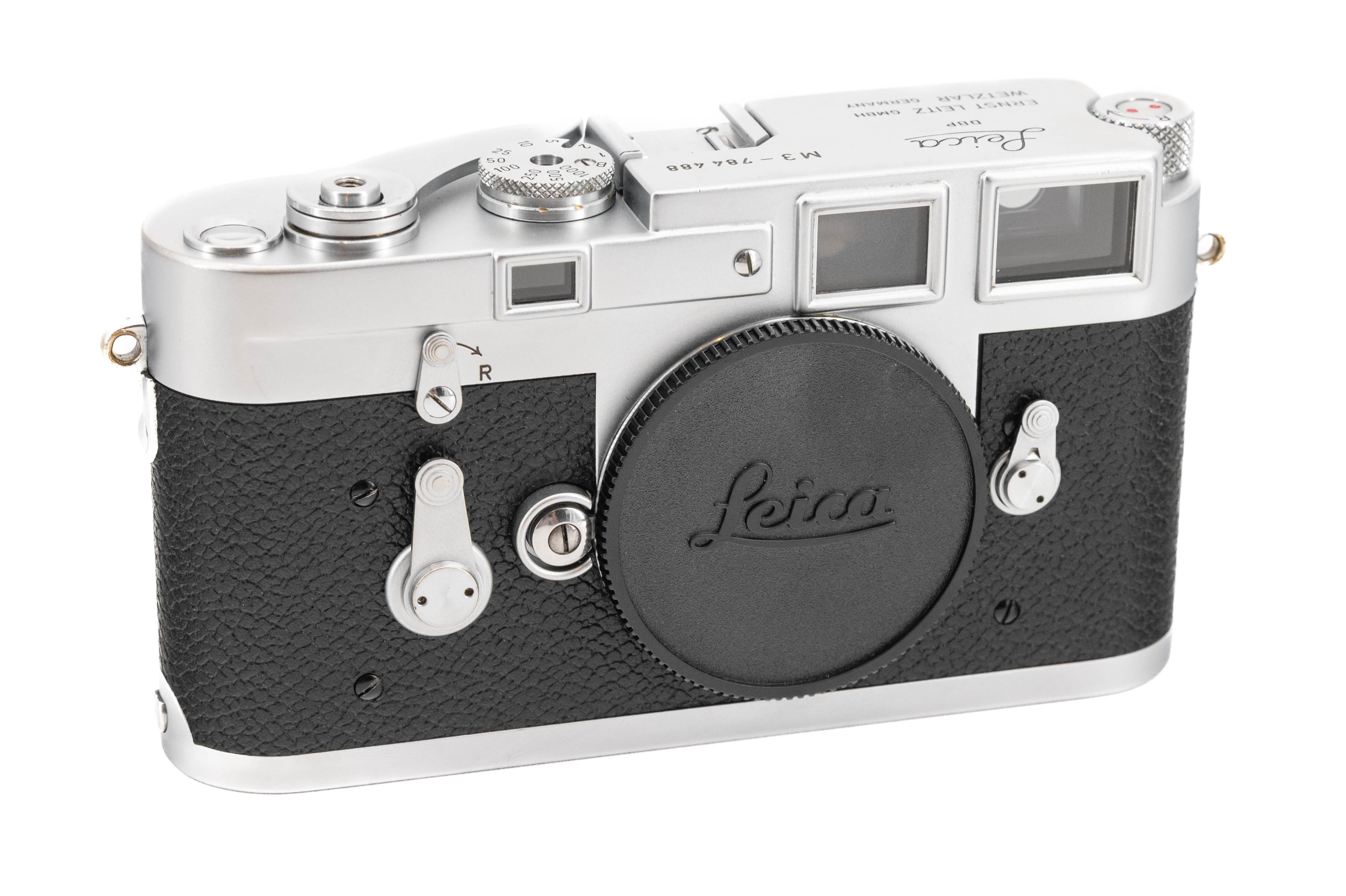
The Leica M3 is the camera that launched the M system in 1954, and it matters because it reset what a 35mm rangefinder could feel like in the hand and at the eye. Its defining moves were the combined bright viewfinder-rangefinder window, the new bayonet M mount, and the rapid film advance lever that broke sharply from Leica’s earlier screw-mount lineage. The M3’s reputation still revolves around that unusually bright finder—especially for 50mm framelines—and the split between single-stroke and double-stroke bodies is exactly the kind of detail collectors and shooters obsess over. If you want the purest statement of classic Leica design, the M3 is where the conversation really starts.
Learn
Why the M3 Still Defines the Leica M Idea
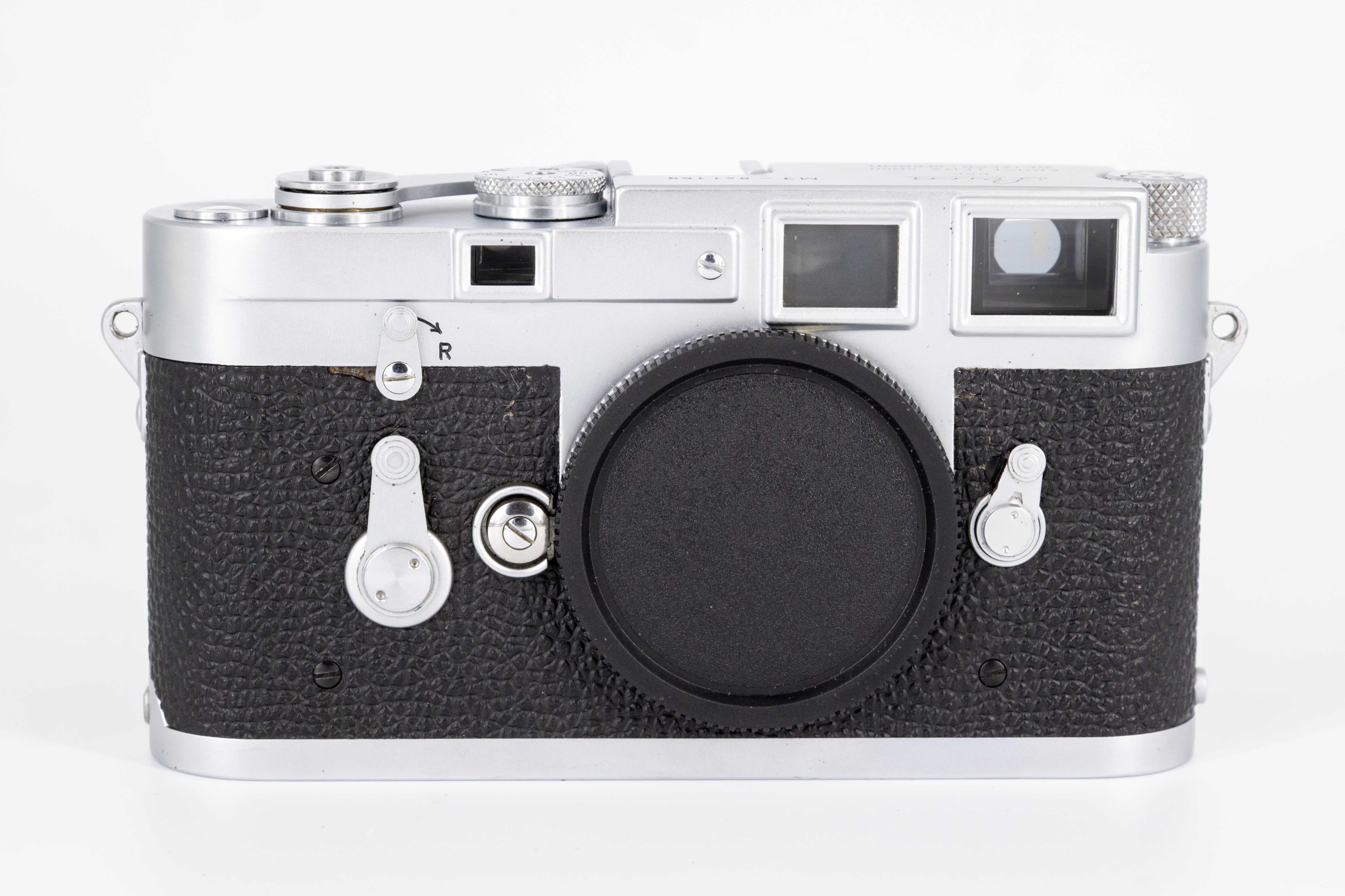
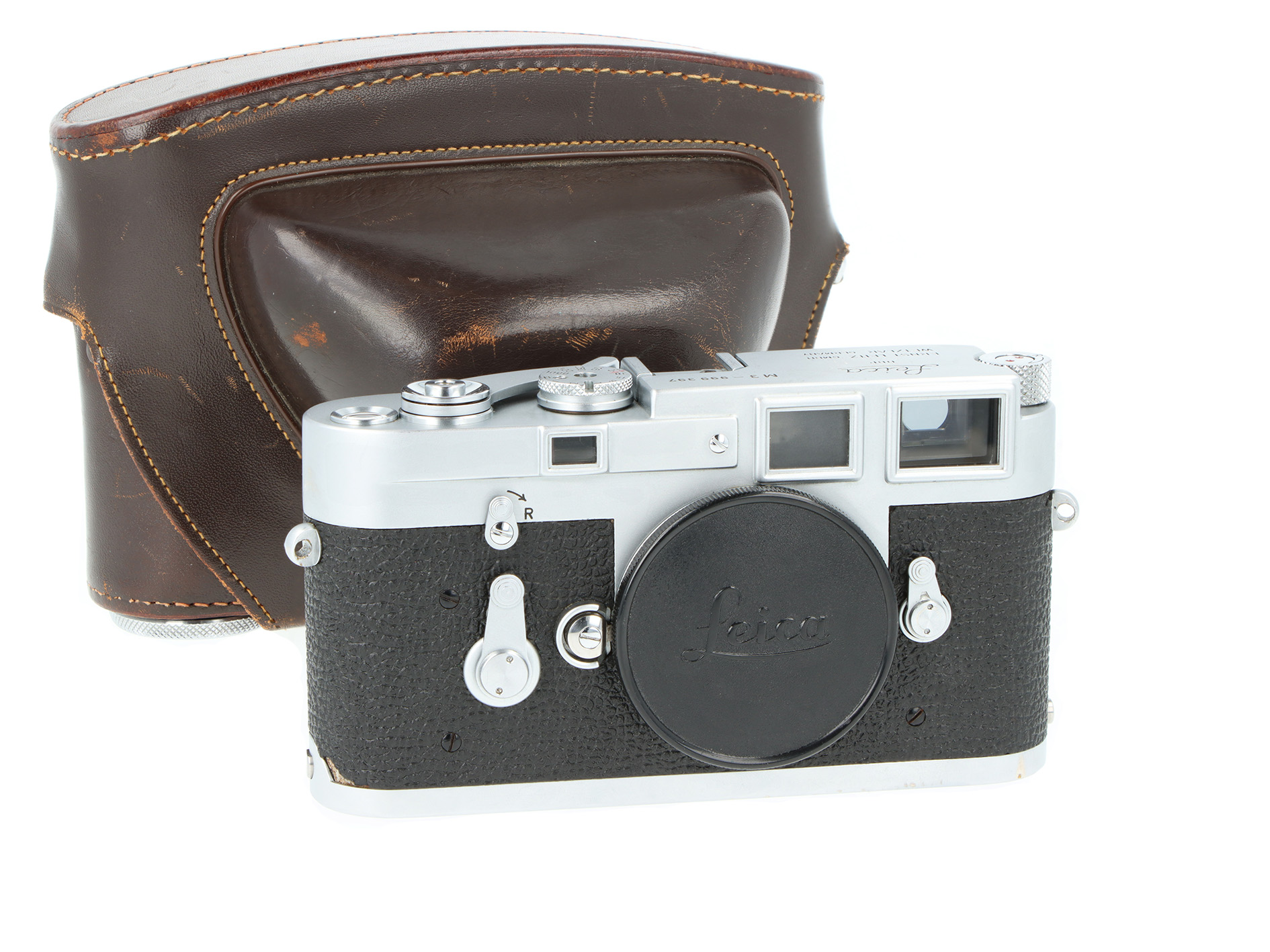
The Leica M3, launched at Photokina in April 1954, didn't just introduce the M-mount——it established the entire template for what a premium rangefinder should be. Its 0.91x magnification viewfinder remains the brightest and most precise of any Leica film or digital M, making it uniquely suited for critical focusing with fast lenses like the 50mm f/0.95 Noctilux. The camera was constantly refined over its twelve-year production run: early double-stroke advance models (serial numbers below ~920,000) gave way to single-stroke versions in 1958, and telltale details like teardrop-shaped strap lugs mark pre-1960s bodies while small round eyelets indicate later examples. By the time production officially ended in 1966, over 220,000 units had been made, and the M3's viewfinder, which never shows extraneous frame lines, is still considered superior to all later M cameras. Despite its age, the M3 remains a fully functional, all-mechanical tool that shoots any 1954–present M-mount lens, and well-worn examples can still be found for under $800.

 leicasocietyinternational.orgleicasocietyinternational.org

 shootitwithfilm.comshootitwithfilm.com
+Field notes
- —The M3's 0.91x viewfinder magnification is higher than any later M (the M9 uses 0.72x, the M7 offers 0.85x at best), which makes the M3 the best Leica for achieving precise focus with ultra-fast lenses like the Noctilux 50mm f/0.95.
- —The M3 never shows more than one set of frame lines at a time——unlike newer Leicas that clutter the viewfinder with multiple lines——and its projected, parallax-compensated framelines automatically index for 50mm, 90mm, and 135mm lenses.
- —Early M3s had a double-stroke film advance and German shutter speeds (1/25, 1/50, 1/100); from 1958 onward the factory switched to single-stroke advance and international speeds, and Leitz even offered a service to convert older bodies.
- —You can instantly date an M3 by its strap lugs: teardrop-shaped eyelets indicate earlier production (pre-1960s), while small round eyelets confirm a later 1960s body.
- —The M3's M-bayonet mount has remained unchanged since 1954, meaning every M-mount lens made in the seven decades since——from 16mm to 400mm——mounts directly and sets the correct framelines automatically.
- —Despite being entirely mechanical and completely meterless, the M3 sold more units than any other Leica M (over 226,000), and clean examples of the single-stroke variant (serial numbers above ~920,000) are the most sought-after for daily use.
Learn
From Screw-Mount Leica to the First M
 leicasocietyinternational.orgleicasocietyinternational.org
 leicasocietyinternational.orgleicasocietyinternational.org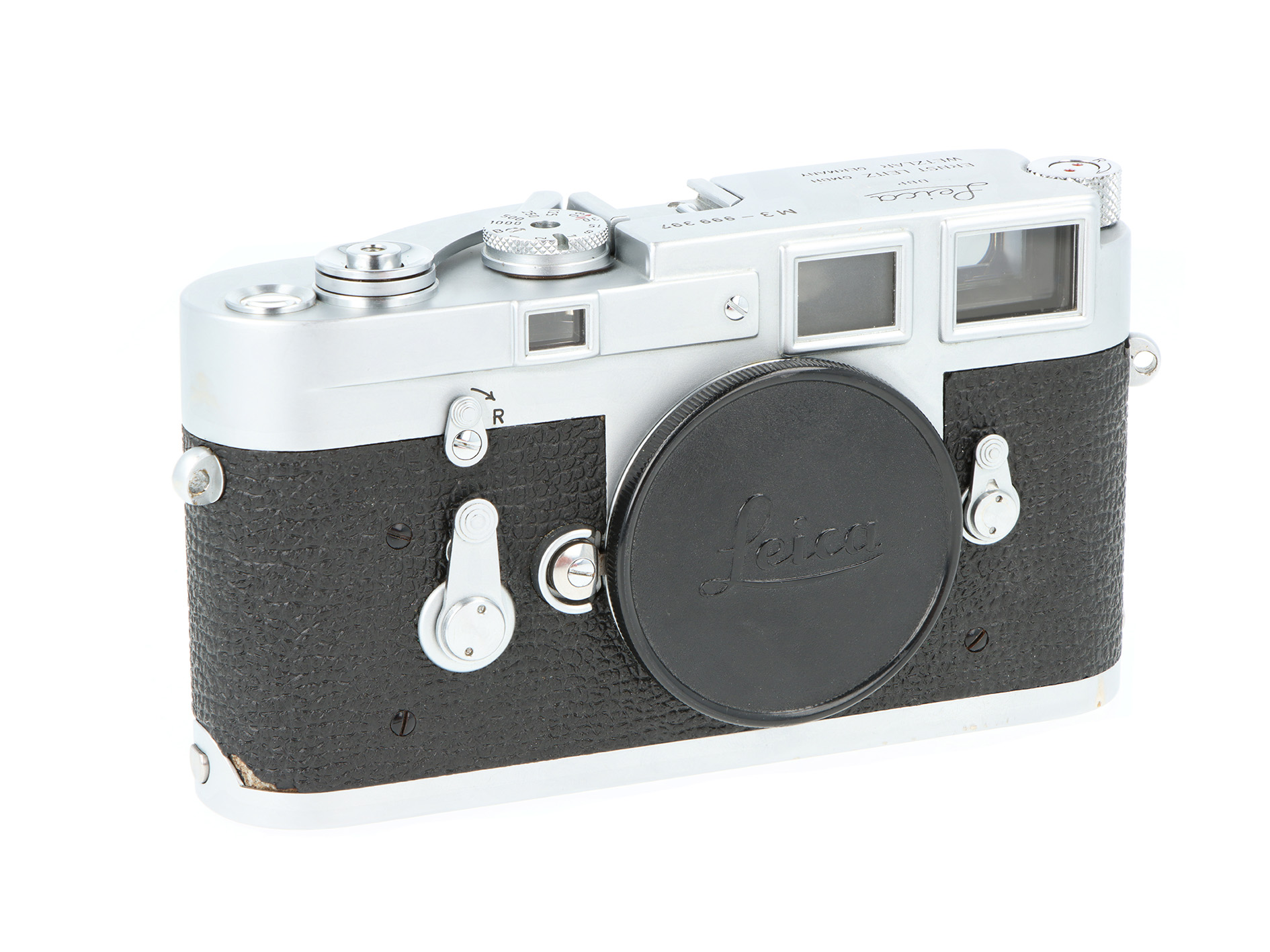

 summichronica.comsummichronica.com
Learn
The Terms M3 Owners Actually Use
In the world of the Leica M3, the vocabulary used by owners reveals a deep appreciation for the camera's mechanical nuances and history. The most immediate distinction is between 'single-stroke' and 'double-stroke' film advance — the latter requiring two sweeps of the lever, a mark of early production. The strap lugs are famously called 'Buddha's ears' (the original teardrop shape) or 'dog ears' (the later round form), a quick visual clue to a body's vintage. The M3's viewfinder is a constant subject of discussion: its 0.91× magnification is the highest of any M camera, and its 'effective base length' of 62.33mm is cited as the reason for its legendary focusing precision, especially when using fast 50mm lenses like the Noctilux. To mount a 35mm lens, owners must use 'goggles' — bulky optical adapters that impose the 35mm frame onto the 50mm viewfinder, or else resort to taping over the finder window. The original 'vulcanite' covering is a rubberized material that often deteriorates, leading to a thriving aftermarket for custom replacement kits from specialists like Aki-Asahi. Finally, the term 'beater' describes a well-used M3, typically a later single-stroke model with a serial number around 920,000 or higher, that shooters choose as a daily camera over pristine collector examples.


+Field notes
- —Owners distinguish early 'double-stroke' M3s (requiring two winding movements) from later 'single-stroke' models (one sweep). Single-stroke bodies, especially those with serial numbers above 920,000, are more sought after for everyday shooting.
- —The strap lugs are called 'Buddha's ears' or 'dog ears' — the earlier teardrop-shaped lugs are 'Buddha's ears,' while round lugs on later 1960s models are 'dog ears.' This is a quick visual tell for dating a body.
- —The M3's viewfinder magnification of 0.91× is the highest of any standard M body, giving an almost 1:1 life-size view. Its effective base length (EBL) of 62.33mm allows exceptionally precise focusing, especially with fast 50mm f/1.0 and f/1.2 lenses.
- —To use a 35mm lens on the M3, owners rely on 'goggles' — optical adapters that fit over the lens and reframe the viewfinder to show the 35mm field of view. Without goggles, some shooters tape over the finder window and use the entire viewfinder as a rough 35mm frame.
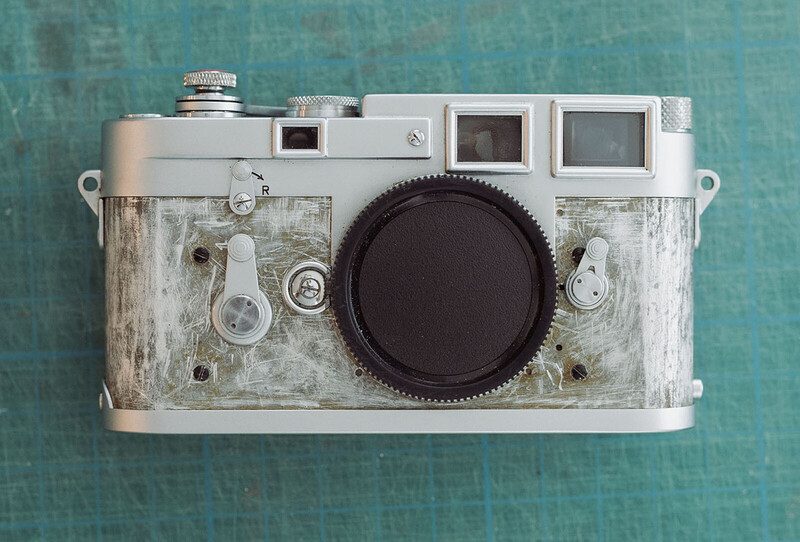
- —The original covering is 'vulcanite,' a hard rubber that often cracks or shrinks with age. Aftermarket kits from companies like Aki-Asahi offer self-adhesive replacements in leather or lizard emboss patterns, keyed to specific M3 variants (with or without finder select lever, Buddha's ear lugs).
- —A 'beater' M3 is a well-used, affordable body — often a single-stroke with a serial number around 920K or later — that shooters prefer over collector-grade examples because it's less precious and more likely to be carried daily.
Explore
Where People Actually Hunt for Good M3 Bodies
For serious M3 hunters, the real action happens on Japanese auction platforms like Yahoo Auctions Japan and JDirectItems, accessed internationally through proxy services such as Buyee. This is where you'll find exactly the kind of bodies that never surface on mainstream classifieds: early production “first lot” units with sought-after serial numbers, professionally overhauled bodies from reputable Tokyo sellers like Sukiya Camera, and rare black-painted factory finishes that show honest wear. The ecosystem is remarkably transparent — sellers post detailed condition notes, starting prices as low as 1 yen, and even specialized repair tools like the 15.8mm ring spanner for M-series disassembly appear regularly. Dedicated reference works like the 13th edition of the *Leica Manual Data Book* (1956) from Morgan & Lester complement these finds, giving buyers the historical and technical background to distinguish a gem from a dud.


+Field notes
- —Japanese proxy service Buyee aggregates listings from Yahoo Auctions Japan and JDirectItems, making it the primary pipeline for M3 bodies that rarely appear on Western platforms — including an early-production 'ファーストロット' (first lot) M3 with a repetitive-digit serial number, sourced from the respected Tokyo dealer Sukiya Camera and already overhauled.
- —Black-painted Leica M3 bodies, finished in factory lacquer that weathers to a distinctive patina, are regularly listed on these Japanese auctions — for example, a 'black painted weathered rangefinder film camera body' sold directly through JDirectItems, a finish coveted by collectors for its rarity and aesthetic.
- —Many M3 listings start at 1 yen with no reserve, driving competitive bidding that can yield good deals — but careful condition reading is essential, as sellers note '動作未確認' (operation unconfirmed) or '現状品' (as-is) on many units.
- —The same Japanese auction ecosystem supplies specialized repair tools like the 15.8mm ring spanner designed specifically for disassembling Leica M3, M2, M4, and MP bodies — an indicator that the community around these cameras is active and self-sufficient.
- —The definitive period reference for evaluating M3 provenance — the 13th edition (1956) of the *Leica Manual Data Book* by Willard Morgan and Henry Lester — is still available secondhand (e.g., on Poshmark for $26), giving buyers technical specs, serial number ranges, and historical context to make informed decisions.
Keep exploring
More of Leica M3 Film Camera

Branch out
Beyond Leica M3 Film Camera
More to explore
In the same world.
Leica M3 Camera
The Leica M3 is the 35mm rangefinder that began Leica’s M-system era in 1954, replacing the company’s earlier screw-moun…

Leica M3
Introduced in 1954 by Ernst Leitz GmbH, the Leica M3 was a radical departure from everything Leitz had built before — re…

Contax T2 Film Camera
The Contax T2 is a premium 35mm compact from 1990 that sits at the exact intersection of luxury object and serious shoot…

Contax T2
The Contax T2 is a high-end 35mm compact film camera that has become a status object as much as a shooter’s tool, prized…
Contax T2 Point-and-Shoot Film Camera
The Contax T2 is a premium 35mm autofocus compact released in 1991 by Kyocera under the Contax name, and its appeal come…
Contax T2 Camera
The Contax T2 is a 1991 autofocus 35mm compact built by Kyocera under the Contax name, and it matters because it turned…

Film Photography
Film photography is the chemical side of photography: images are recorded on gelatin film, paper, or even hard plates ra…

Technics SL-1200 M3D
The Technics SL-1200 M3D is a quartz direct-drive SL-1200 variant that kept the core performance of the earlier 1200 for…
More in Film & Analog Photography
Stay in this world.
Contax T2 Point-and-Shoot Film Camera
Contax T2 Film Camera
Contax T2 Camera
Contax T2
Film Photography
Leica M3
Imagery
Know someone who’d love this?
Discovered by ArcurianAuto-generated from public sources and AI synthesis — it may be incomplete or inaccurate. Treat it as a starting point for your own exploration, not professional (medical, legal, financial, or safety) advice. Verify anything you act on. Report this page.