The Rolex Deepsea is Rolex’s 44 mm extreme-depth diver, introduced in 2008 as the brand’s purpose-built watch for deep-sea exploration rather than ordinary desk-diver fantasy. Its identity is inseparable from the Ringlock system, a helium escape valve for saturation diving, and a 3,900 metre water-resistance rating that pushes far beyond human scuba limits. Within the current lineup, collector attention naturally splits between the black-dial Oystersteel model and the D-blue gradient dial that commemorates James Cameron’s historic solo dive, while the newer yellow-gold version shows how far this once purely brutal tool watch has evolved. If you want the Rolex line where engineering, oversized wrist presence, and modern collector taste collide, this is the one to study closely.
Learn
What the Deepsea Actually Is
The Rolex Deepsea isn't just another dive watch; it's a specific engineering solution to a problem most watches never face: surviving the pressure at 3,900 meters (12,800 feet). At its heart is the patented Ringlock System, a three-part case architecture that rethinks how a watch resists depth. Instead of simply making the case walls thicker—which would lead to absurd proportions—Rolex uses a nitrogen-alloyed steel compression ring (or blue ceramic on the gold model) to bear the brunt of the pressure, sandwiched between a 5.5mm domed sapphire crystal and a caseback made of RLX titanium [2][5][6]. This system allows the 44mm Deepsea to be smaller than it would be with a traditional design [6]. The current reference 136660, released in 2022, refines the formula with a slightly slimmer bezel that lets the crystal sit more prominently, an enlarged date window, and a titanium caseback stamped 'RLX Titanium' [1][7]. The Deepsea is available with a black dial or the iconic D-Blue 'James Cameron' gradient dial, which transitions from deep blue to near-black [1]. In 2024, Rolex introduced the first precious-metal Deepsea in 18k yellow gold (ref. 136668LB) and formally dropped the 'Sea-Dweller' name from the dial, establishing the Deepsea as its own distinct collection [3][7]. This is not a watch for subtlety or dress cuffs; it is a purpose-built instrument of extreme over-engineering, designed to survive conditions no human will ever physically experience.

 watchguys.comwatchguys.com


 watchlimit.comwatchlimit.com
+Field notes
- —The Deepsea's Ringlock System uses a nitrogen-alloyed steel compression ring (or blue ceramic on gold models) to absorb pressure, enabling the 3,900-meter depth rating without the watch becoming impractically oversized.
- —On the current ref. 136660 (2022), Rolex shaved down the bezel profile so the 5.5mm-thick domed sapphire crystal protrudes more prominently, creating a cleaner, slightly less industrial look than its predecessor.
- —The 136660's titanium caseback is stamped with 'RLX Titanium'—a specific high-performance alloy mark—and this single material change makes the watch noticeably lighter on the wrist than the previous steel-backed 126660.
- —Rolex removed the folding 'Fliplock' diver's extension from the 136660's clasp, acknowledging that most owners never wear the watch over a drysuit, resulting in a thinner, more comfortable clasp for daily wear.
- —In 2024 Rolex introduced the first precious-metal Deepsea—ref. 136668LB in 18k yellow gold with a blue dial and blue ceramic bezel—and simultaneously dropped the words 'Sea-Dweller' from all Deepsea dials, making it a standalone collection.
- —The helium escape valve on the Deepsea is unidirectional and automatically releases helium atoms when internal case pressure exceeds external pressure, preventing the crystal from being blown off during saturation diving decompression.
Learn
From 2008 Launch to the Current 44 mm Line
The Rolex Deepsea line launched in 2008 with the ref. 116660, instantly becoming Rolex's most extreme production dive watch thanks to its patented Ringlock System—a nitrogen-alloyed steel compression ring, a 5.5mm-thick domed sapphire crystal, and an RLX titanium caseback—that together deliver a water resistance of 3,900 meters (12,800 feet), tested at 125% of that depth. The 44 mm case, with 17.7 mm thickness, set a new benchmark for over-engineered tool watches. The James Cameron D-Blue variant appeared in 2014 (also ref. 116660), its gradient dial from ocean blue to black a direct reference to the filmmaker's 2012 solo dive to the Challenger Deep in the Mariana Trench. Over three generations—116660 (2014–2018), 126660 (2018–2022), and 136660 (2022–present)—the James Cameron edition evolved from the Caliber 3135 movement with 48-hour power reserve to the Caliber 3235 with 70-hour reserve and improved lugs for comfort, though the 136660 controversially removed the flip-lock extension from the bracelet. In 2024, Rolex further refined the line by dropping the words 'Sea-Dweller' from the dial, cementing the Deepsea as a standalone collection, and adding a yellow-gold variant (ref. 136668LB) while continuing the titanium Deepsea Challenge (ref. 126067) for the truly extreme.


 atlaswatcheslondon.comatlaswatcheslondon.com

 crownvintage.com.aucrownvintage.com.au
+Field notes
- —The 2008 launch of the Rolex Deepsea ref. 116660 introduced the Ringlock System—a patented case architecture using a compression ring of nitrogen-alloyed steel, a 5.5mm sapphire crystal, and a titanium caseback—enabling a depth rating of 3,900 meters (12,800 feet).
- —The James Cameron D-Blue dial, first seen on the 116660 in 2014, uses a gradient from deep blue to black to symbolize Cameron's descent into the Mariana Trench, with the green 'DEEPSEA' text matching the color of his submersible Deepsea Challenger.
- —The 126660 (2018–2022) upgraded from the Caliber 3135 to the Caliber 3235 movement, increasing power reserve from 48 to 70 hours and adding the Chronergy escapement for improved efficiency, alongside slimmer lugs and a wider bracelet for better wrist comfort.
- —The current 136660 (2022–present) removed the flip-lock extension from the bracelet—a polarizing change that streamlines the clasp but eliminates a practical dive feature present on both the 116660 and 126660.
- —In 2024, Rolex removed the words 'Sea-Dweller' from the Deepsea dial, establishing the Deepsea as its own distinct collection, and introduced the first precious-metal version—a yellow-gold ref. 136668LB with a blue dial and blue Cerachrom bezel.
- —The Deepsea's depth rating of 3,900 meters is validated by testing at 125% of that figure (4,875 meters) in a hyperbaric tank developed with Comex, meeting the ISO 6425 standard for divers' watches.
Learn
The Terms Collectors Use: Ringlock, D-Blue, HEV, Cerachrom
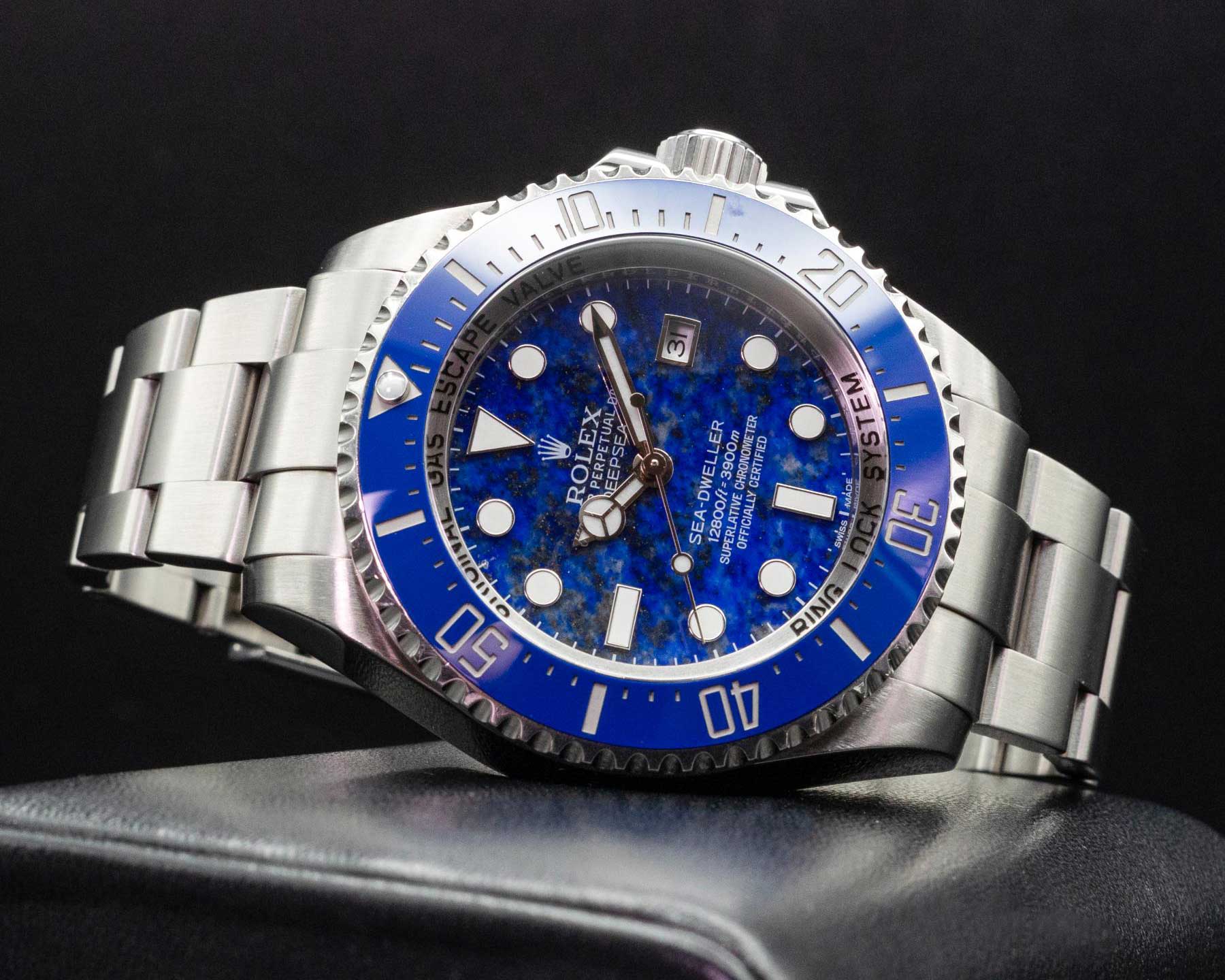
The Rolex Deepsea, launched in 2008, is a marvel of underwater engineering that collectors dissect through specific jargon. At its heart is the patented Ringlock system, a radical case architecture that sandwiches a 5.5 mm domed sapphire crystal, a compression ring (nitrogen-alloyed steel or blue ceramic), and an RLX titanium case back to withstand 3,900 m of pressure. The helium escape valve (HEV) at 9 o'clock, patented in 1967, automatically vents helium atoms during saturation diving decompression to prevent crystal blow-off. The bezel uses a Cerachrom ceramic insert with platinum PVD-coated numerals, virtually scratchproof and glossy black. On the bracelet, the Fliplock extension—three folding blades hidden under the clasp—adds 26 mm of length for wearing over a wetsuit, complementing the Glidelock fine-adjustment system. Collectors pore over these elements to authenticate watches, as counterfeits routinely fail to replicate the precise machining of the HEV, the depth of Ringlock engravings, or the AR-coated sapphire's subtle blue-purple tint.


 rolex.comrolex.com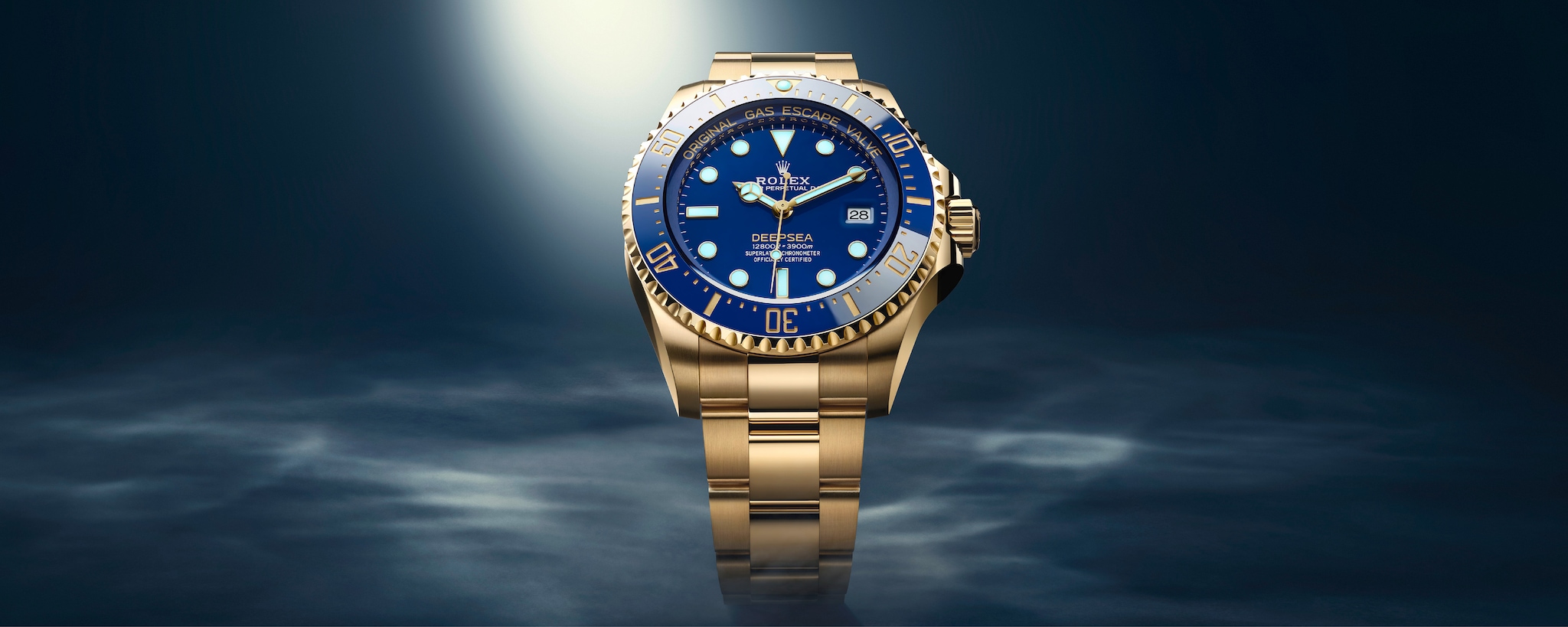
 newsroom.rolex.comnewsroom.rolex.com
+Field notes
- —The Ringlock system uses three superimposed components — a 5.5 mm thick sapphire crystal, a high-performance compression ring (nitrogen-alloyed steel on steel versions, blue ceramic on the yellow gold version), and an RLX titanium case back — that together bear the extreme pressure at 3,900 m (12,800 ft).
- —Rolex's patented Helium Escape Valve (HEV), introduced in 1967, is a unidirectional safety valve at 9 o'clock that automatically releases helium atoms during decompression, preventing damage from internal pressure buildup when the watch is used in saturation diving.
- —The Deepsea's Cerachrom bezel insert is made from virtually scratch-proof black ceramic with numerals and graduations engraved and filled with platinum via PVD coating, giving a deep glossy finish that counterfeits cannot replicate with painted aluminum or low-grade ceramic.
- —The bracelet features both the Glidelock fine-adjustment system (20 mm of micro-adjustment) and the Fliplock extension link (26 mm) — three folding blades concealed under the clasp that allow the watch to fit over a wetsuit up to 7 mm thick.
- —The 2024 Rolex Deepsea in 18 ct yellow gold introduced a blue Cerachrom bezel insert and a blue lacquer dial with 'DEEPSEA' in powdered yellow, along with a Cerachrom compression ring inside the Ringlock system — a first for ceramic in the case architecture.
- —The 5.5 mm domed sapphire crystal has an anti-reflective coating on the inner surface, giving a faint blue or purple tint under side light — significantly thicker than any other Rolex sport model and a key authentication marker.
Discover
Video Coverage Worth Watching Before You Try One On
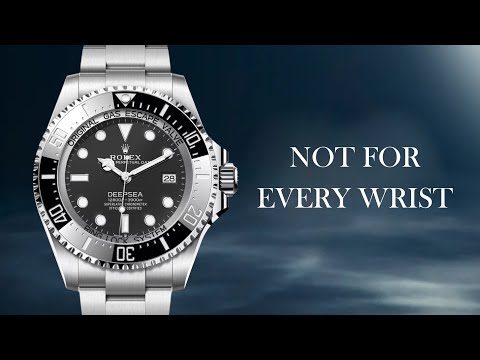

Before you even think about strapping a Rolex Deepsea on your wrist, you need to understand that this is not a watch you casually try on — it's a statement of sheer mass and engineering that will either dominate your arm or overwhelm it. The modern reference 136660, especially the James Cameron D-Blue edition with its gradient dial mimicking the Mariana Trench, is a 44mm stainless steel beast that weighs in at over 200 grams on an Oyster bracelet, making the Submariner feel like a dress watch. Videos stress that the thickness — roughly 17.7mm — is the real issue; it won't slide under a shirt cuff and will bang against door frames. But the surprise is how the graded dial and the titanium caseback (on the James Cameron version) trick your mind into thinking it's lighter than it is. The helium escape valve at 9 o'clock is there for saturation diving, but for 99% of buyers it's just a conversation starter. These reviews also warn that the black dial version feels more tool-like and less flashy, while the gold Deepsea (reference 136668) is an entirely different beast — 18k yellow gold that pushes the weight past 350 grams, a true wrist anchor. The key takeaway: watch the videos to gauge how big it looks on a wrist that's not yours, because the Deepsea wears huge even on 7.5-inch wrists, and the D-Blue dial's gradient is the only thing that softens its visual bulk.
+Field notes
- —The Rolex Deepsea 136660 is 44mm wide and roughly 17.7mm thick — the thickness, not the width, is what makes it unwearable under a dress shirt and what reviewers consistently call the dealbreaker for most people.
- —The James Cameron D-Blue gradient dial (dark blue to black) was introduced on the 116660 in 2014 to celebrate Cameron's solo dive to the Challenger Deep, and the current reference 136660 (2022–present) uses a titanium caseback that slightly reduces perceived weight, though not actual heft.
- —There have been three James Cameron D-Blue references: the 116660 (2014–2018), the 126660 (2018–2022), and the current 136660 (2022–present) — each with incremental updates like the movement (from 3135 to 3235) and the titanium caseback arriving in the 136660.
- —The black dial version (reference 136660-0001) is less common in video reviews and is described as a more stealth, tool-watch look compared to the D-Blue's peacock-like gradient, which catches light in a way that the black dial simply cannot.
- —The gold Deepsea (reference 136668) in 18k yellow gold is a separate collector's item — reviewers warn it's ludicrously heavy (over 350g) and should only be considered by someone who wants a gold watch that doesn't look delicate, as even a brief try-on will make your arm feel the difference.
Discover
Follow the People Photographing and Wearing Deepseas Well
The Rolex Deepsea's most compelling wearers aren't just collectors—they're explorers, cinematographers, and technical divers who treat the watch as a genuine tool. James Cameron's own D-Blue model, with its distinctive gradient dial fading from deep blue to black, commemorates his 2012 solo dive to the Challenger Deep and has become an icon of extreme watch use. The community around the Deepsea is surprisingly small, revolving around a few key YouTube reviewers like SwissWatchExpo who pit the standard black dial against the D-Blue and the full 18k yellow gold reference 136668. What sets these owners apart is their willingness to actually dive with the watch—the 3,900-meter water resistance isn't just marketing, and real-world deep-sea photographers and saturation divers post wrist shots from submersibles and decompression chambers. The most unusual subset are those who seek out the original 2008 reference 116660, the 'James Cameron' before it had a nickname, distinguished by its thicker case and the rare 'DEEPSEA' engraving on the clasp.
+Field notes
- —James Cameron's personal D-Blue model (ref. 126660-0002) features a distinctive gradient dial that transitions from deep blue at the top to nearly black at the bottom, a design choice that directly references the darkening light conditions as you descend below 1,000 meters.
- —SwissWatchExpo's 2026 comparison video pits the standard black dial ref. 136660 against the D-Blue ref. 136660 and the solid 18k yellow gold ref. 136668, showing that even within the Deepsea line, there are three distinct buyer profiles: the tactical tool user, the Cameron tribute enthusiast, and the luxury diver.
- —The Deepsea's 44mm case is rarely worn casually; its owners tend to be serious divers or watch enthusiasts who post on specialized diving watch forums, often showing their watches alongside actual dive computers and decompression tables.
- —A tiny but dedicated group seeks out the original 2008 reference 116660, which lacks the D-Blue dial option and has a noticeably thicker case profile than the current 136660, along with the rare 'DEEPSEA' engraving on the clasp that was phased out in later years.
- —Actual deep-sea photographers like those working on James Cameron's 'Deepsea Challenge' project have been photographed wearing pre-production Deepsea prototypes, making their images the holy grail for collectors who value provenance over spec sheets.
Explore
Where to Track Real Market Listings and Compare Configurations
Poshmark is a surprisingly useful window into the real-world secondary market for the Rolex Deepsea, but you have to know what you’re looking at. Listings like the reference 126660 in Oystersteel with a black dial and full set (box, papers, tags) show up at around $16,500, with the platform’s included authentication service acting as a buyer-safety net. The comments sections are gold for spotting negotiation dynamics and catching sellers who confuse models (the 126660 is 44mm, not 36mm). But for every legitimate listing, there’s a $400 ‘Deep Sea-Dweller’ with a blue dial and a misspelled ‘Original Gas Escape Valve’ ring—a dead giveaway that it’s a fantasy piece, not a real Rolex. The real Deepsea’s 5.5mm-thick domed crystal, helium escape valve, and Glidelock/Fliplock bracelet extension are engineering signatures that fakes almost never get right.


+Field notes
- —The current-production Deepsea is the reference 126660 (or its successor 136660), distinguishable by its 44mm Oystersteel case, 5.5mm domed crystal, and the 3235 movement with 70-hour power reserve—specs that appear verbatim in authentic listings like the one on Poshmark at $16,500.
- —Poshmark’s built-in authentication service is free on every watch listing over $500, which means the platform acts as a first-pass gatekeeper against fakes—but the $400 ‘Deep Sea-Dweller’ with a blue dial and a misstated ‘Original Gas Escape Valve’ ring shows the system isn’t perfect, or the listing slipped through before review.
- —The comment sections on Poshmark reveal real market behavior: in the Sea-Dweller 16600 listing, buyers haggle openly and sellers offer alternative payment methods like PayPal, indicating that the listed price is often just a starting point for negotiation, not a firm market value.
- —Comparing configurations on Poshmark is tricky because sellers frequently mix up reference numbers and sizes—one listing for a ‘2008 SeaDweller 16600’ initially claimed 36mm before the seller corrected it to 40mm, a common source of confusion for anyone trying to track the 44mm Deepsea specifically.
- —The Deepsea’s Glidelock extension system and Fliplock extension link—mentioned in detail on the authentic 126660 listing—are distinctive to the model and rarely replicated correctly in counterfeits, making them a quick visual check when scrolling through listings.
Keep exploring
More of Rolex Deepsea


Branch out
Beyond Rolex Deepsea
More to explore
In the same world.

Rolex Deepsea
The Rolex Deepsea is Rolex’s 44 mm extreme-depth dive watch, built around the brand’s Ringlock system and rated to 3,900…
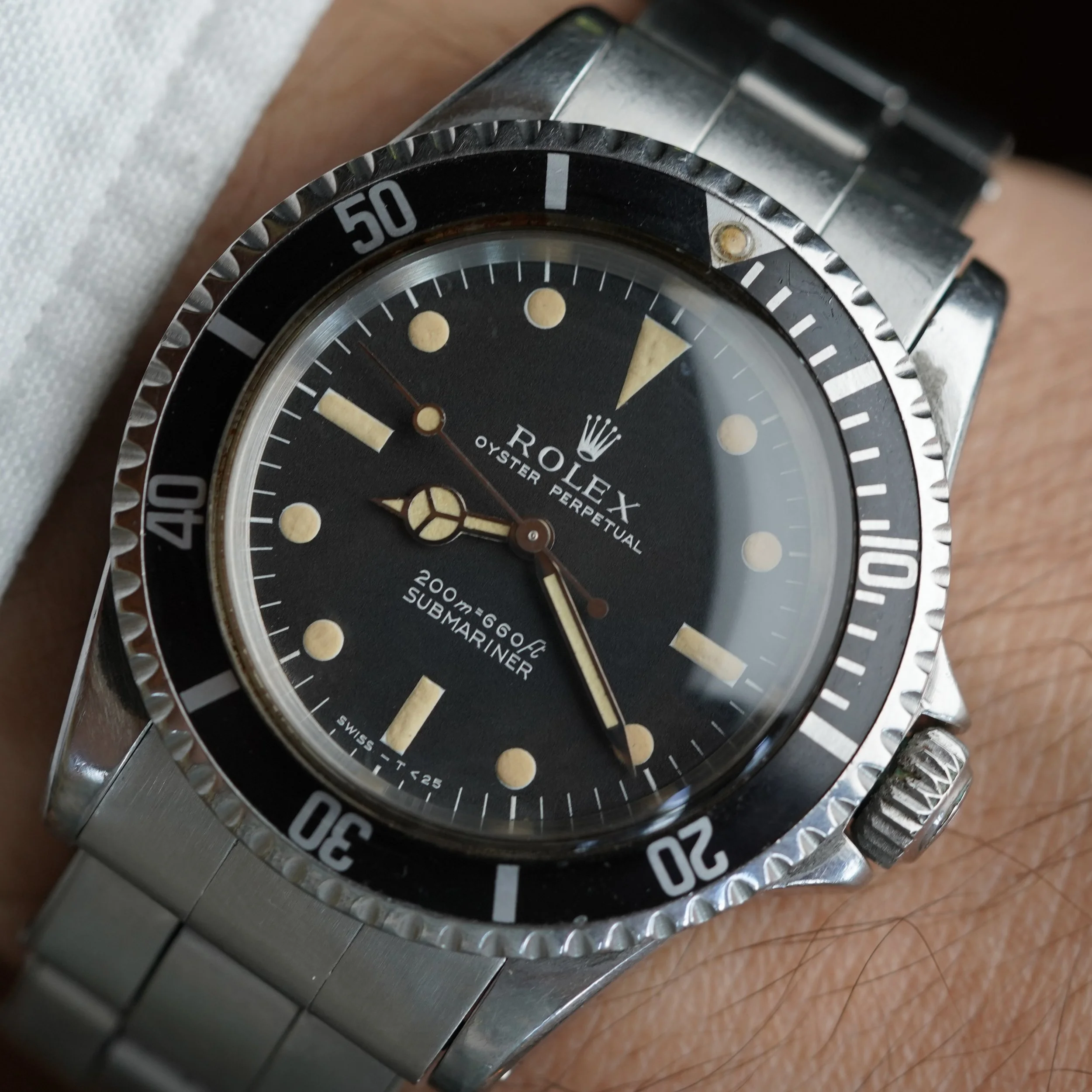
Vintage Rolex Submariner
When Rolex introduced the Submariner in 1953, it permanently defined what a dive watch could be — a purpose-built tool t…
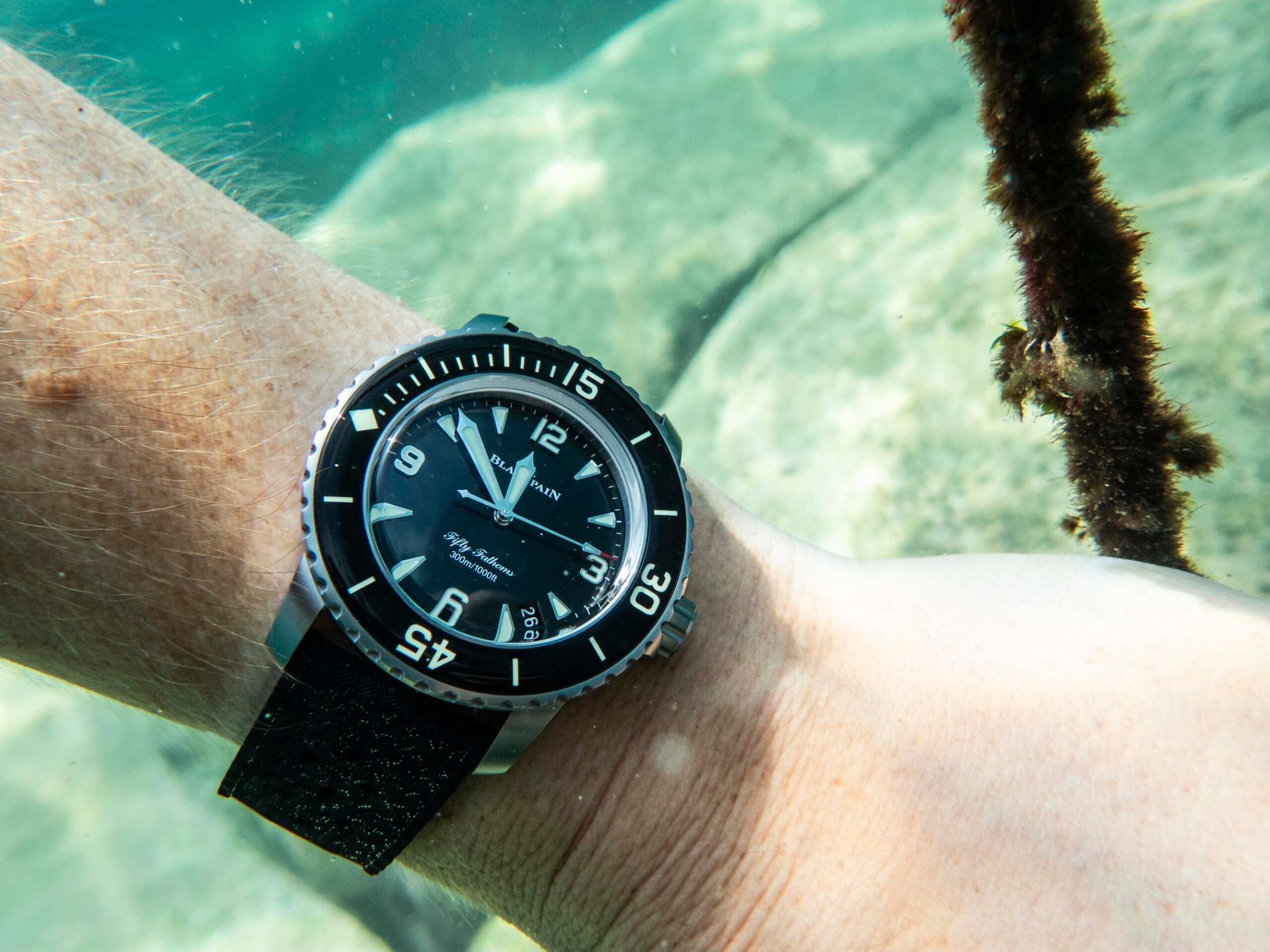
Blancpain Fifty Fathoms
The Blancpain Fifty Fathoms is the brand’s long-running diver’s-watch family, spanning core Fifty Fathoms Automatique mo…

Vintage Rolex Watches
Vintage Rolex collecting revolves around older references whose value is tied not just to the model name, but to origina…
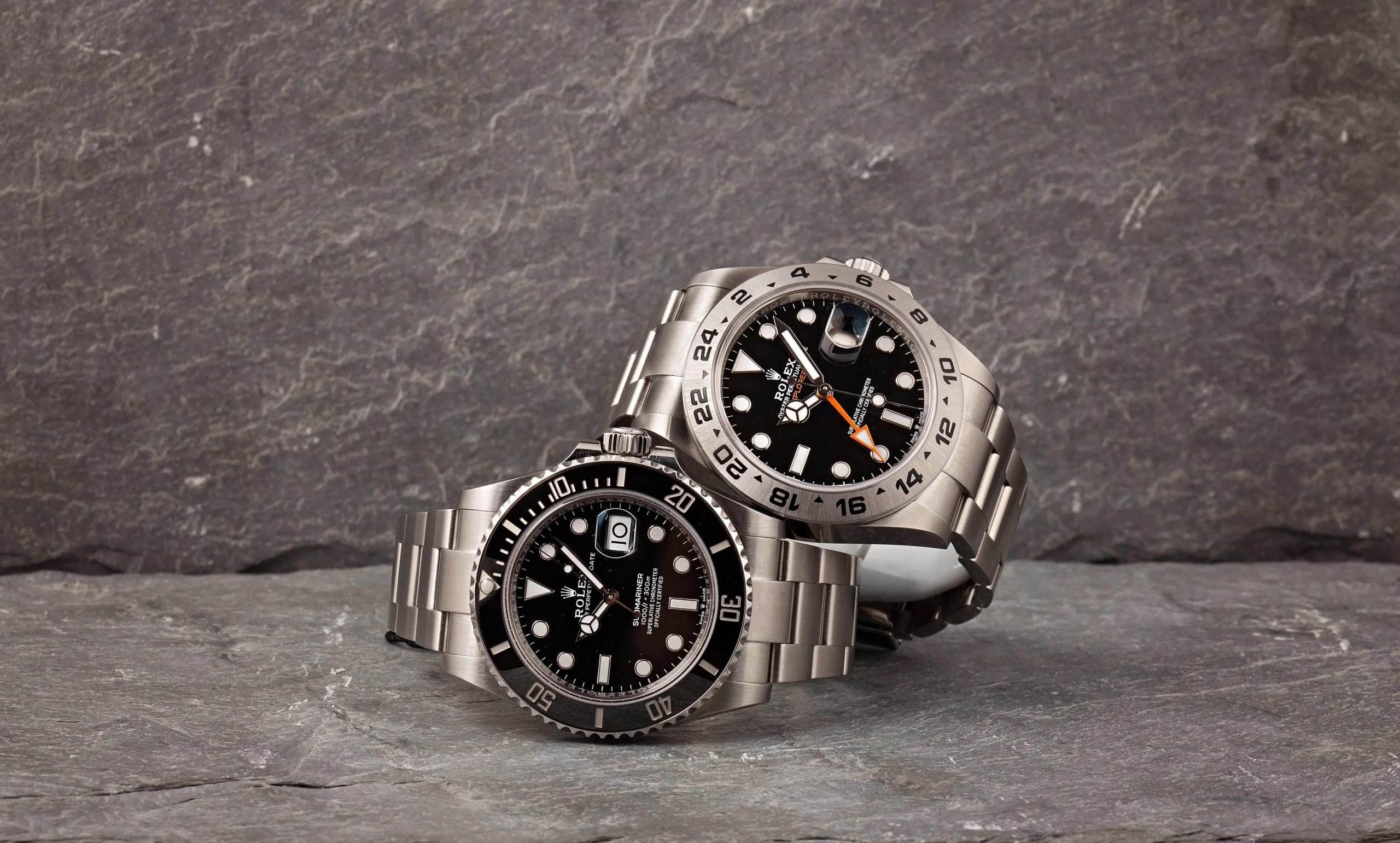
Panerai and Rolex
Panerai and Rolex meet in a way many newcomers miss: beyond today’s brand comparisons, early Panerai military watches we…
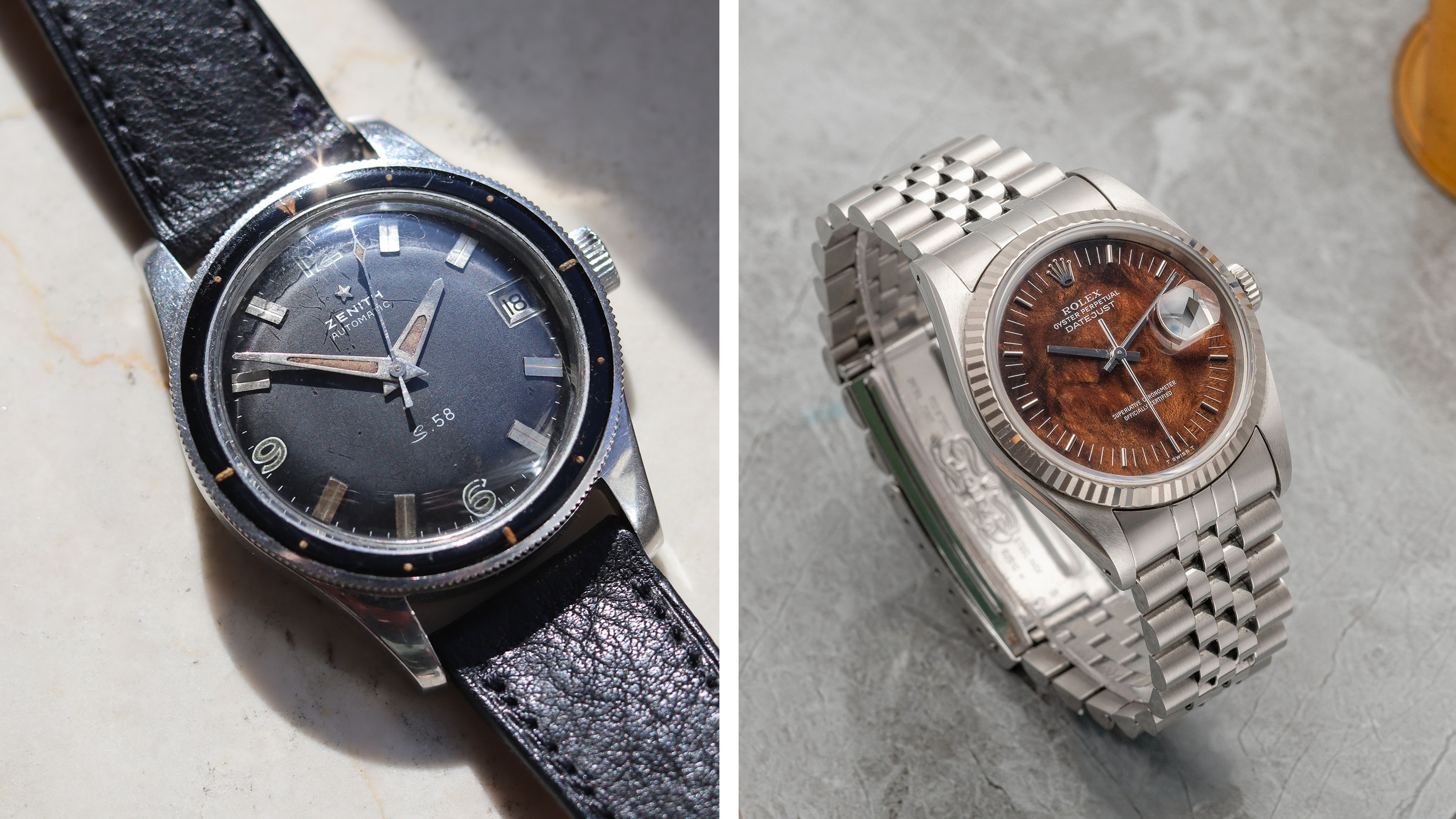
Best First Luxury Watch
A first luxury watch is less about chasing a single “best” model than making a high-stakes first purchase with clear tra…

Military Watches
Military watches sit at the intersection of real field use, instrument design, and modern tool-watch collecting: brands…

Vintage Omega Speedmaster
Vintage Omega Speedmasters sit at the intersection of tool-watch history, lunar mythology, and exacting collector schola…
More in Watches & Horology
Stay in this world.
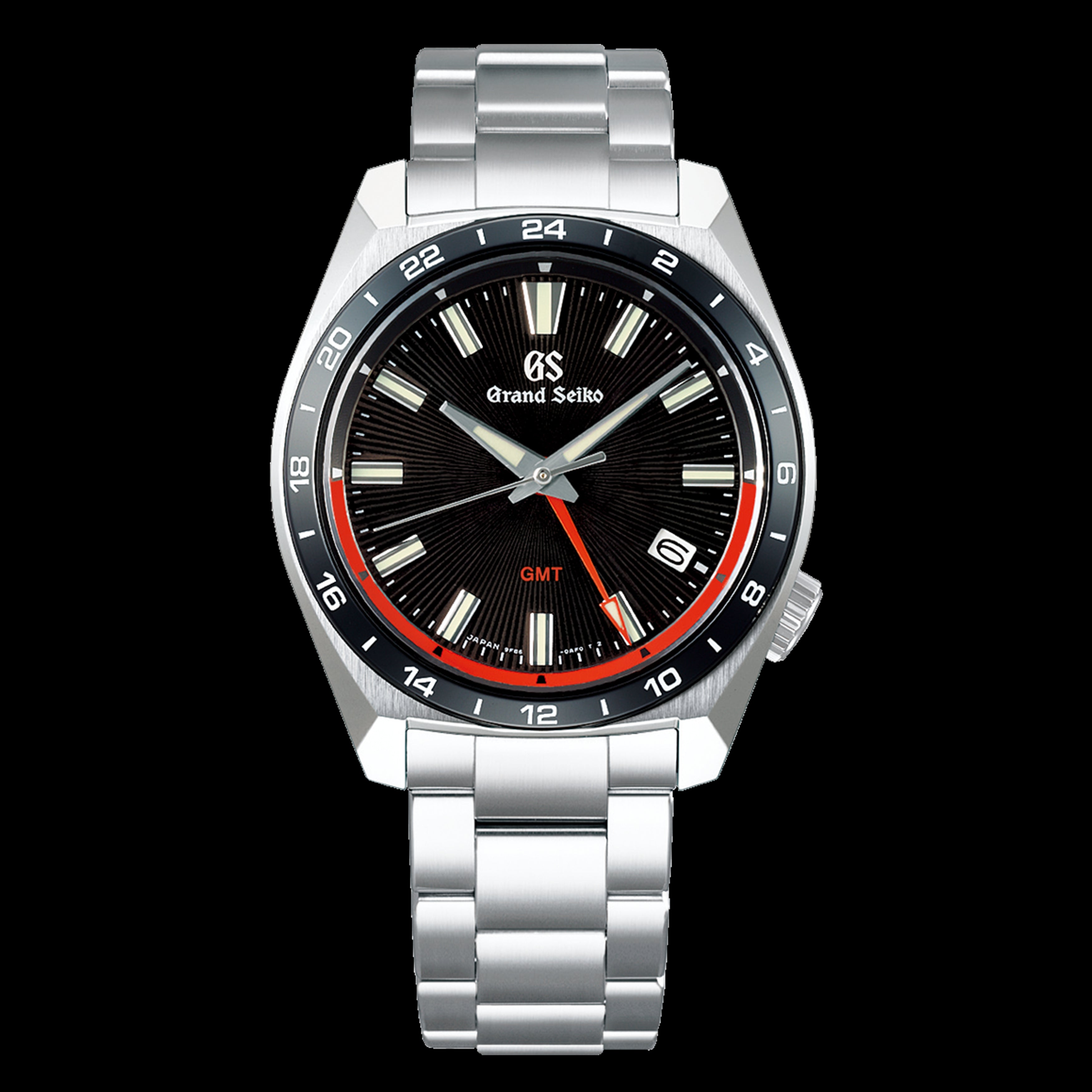
Grand Seiko SBGN001 9F GMT
Vintage Watch Hunting
Rolex Deepsea
Luxury Watches That Hold Value
Best Luxury Quartz Watches
Skeletonized Haute Horlogerie
Best First Luxury Watch
Benyar Watches
Imagery
Know someone who’d love this?
Discovered by ArcurianAuto-generated from public sources and AI synthesis — it may be incomplete or inaccurate. Treat it as a starting point for your own exploration, not professional (medical, legal, financial, or safety) advice. Verify anything you act on. Report this page.