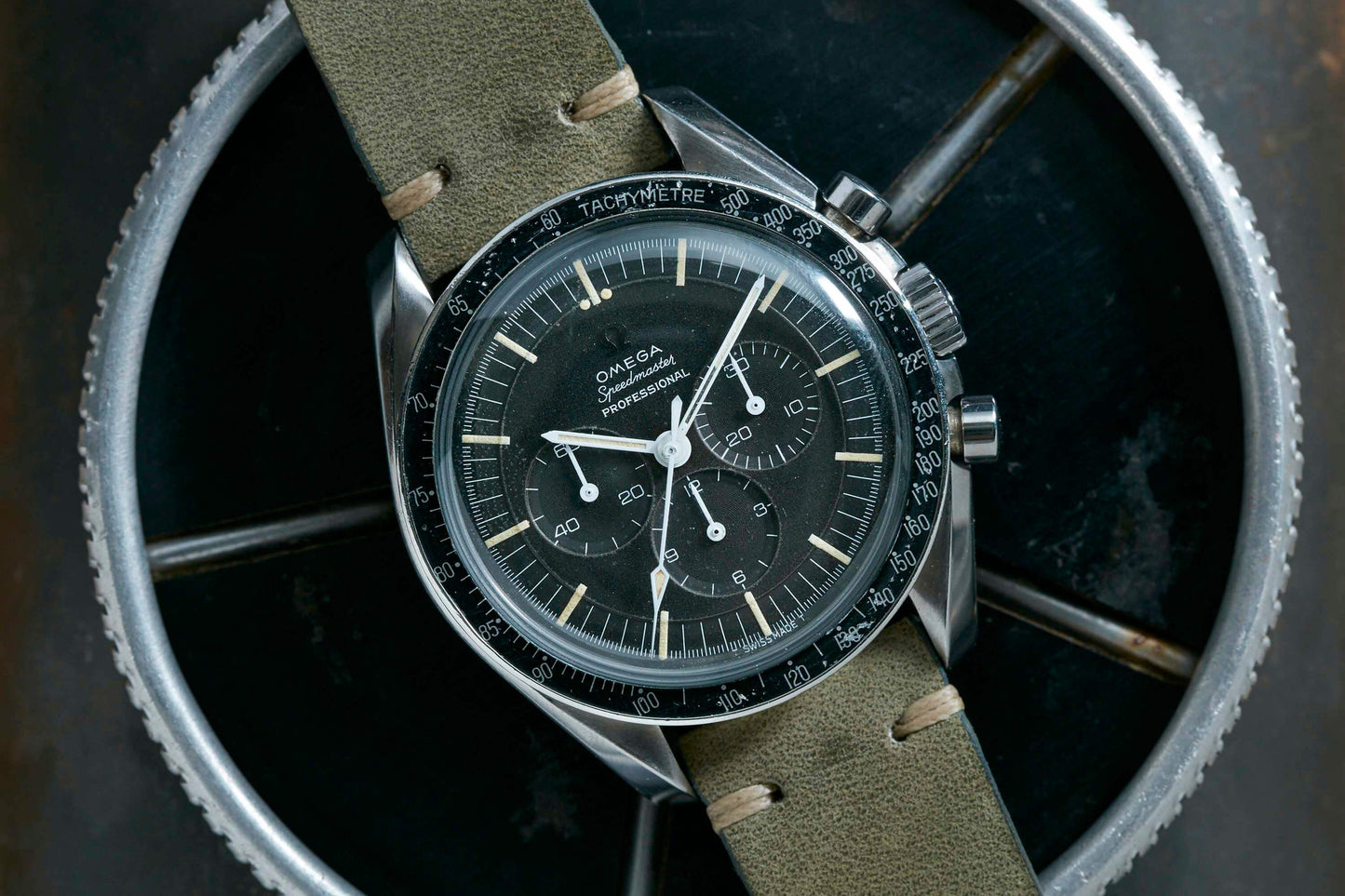
Vintage Omega Speedmasters sit at the intersection of tool-watch history, lunar mythology, and exacting collector scholarship. The hunt is thrilling because production changed constantly from the 1957 reference 2915 onward, and buyers have to sort original watches from altered examples in a market even seasoned enthusiasts describe as a minefield. Insiders obsess over distinctions like caliber 321 versus 861, “Pre-Moon” references such as 105.003 and 105.012, and transitional pieces like the Seamaster Speedmaster ST 105.0003. If this world grabs you, the real appeal is not just owning a Moonwatch ancestor—it is learning to read the tiny clues that separate a great watch from an expensive story.
Learn
How to Read the Vintage Speedmaster Landscape
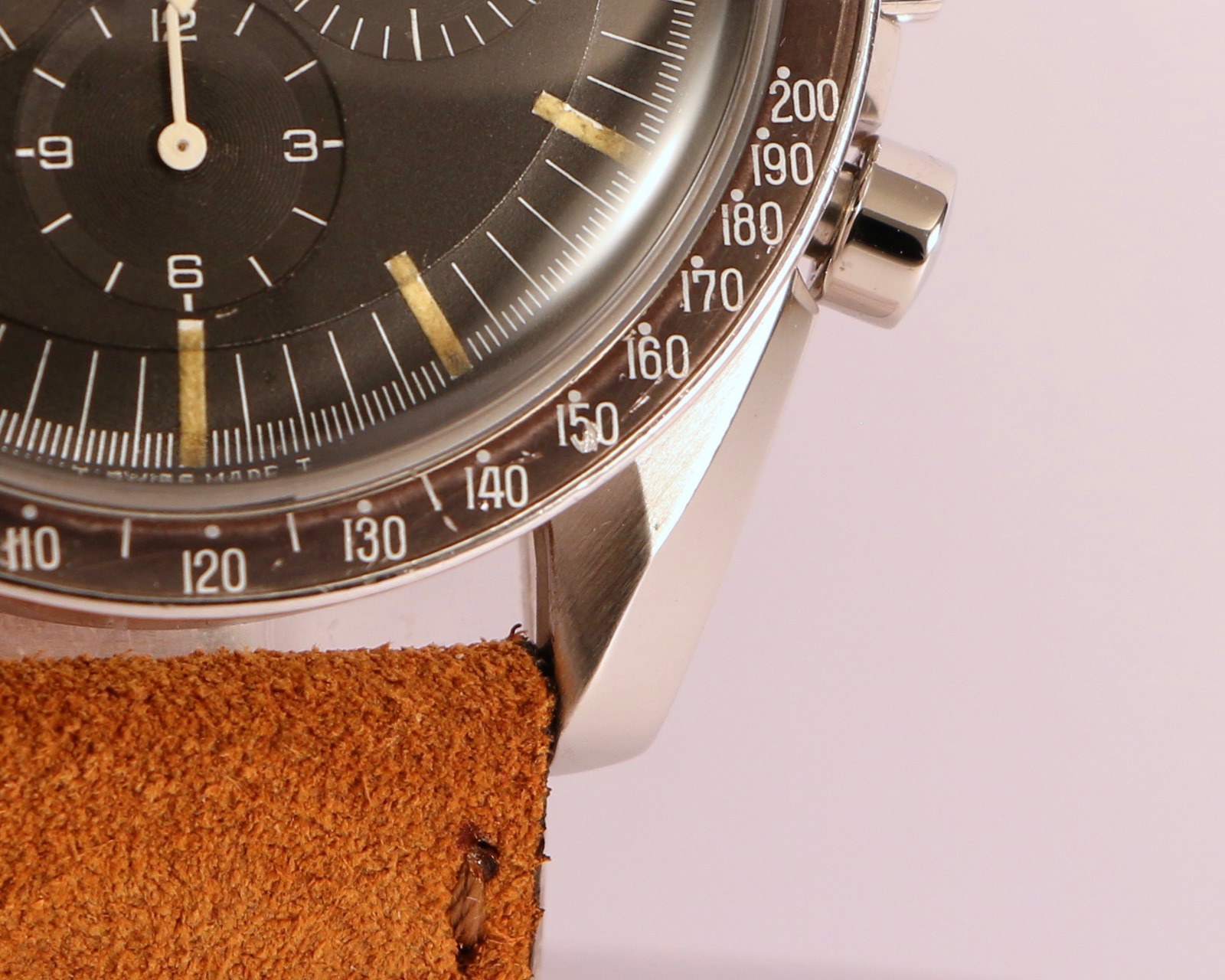
The vintage Speedmaster landscape is a minefield of subtle variation and deliberate deception, where the same reference can swing from $4,500 to nearly $30,000 based on condition, originality, and what collectors call 'attraction.' The seven core references from 1957 to 1978—2915, 2998, 105.002, 105.003, 105.012, 145.012, and 145.022—look superficially similar but carry radically different values and tell-tales. The 105.003 'Ed White' is the most prolific straight-lug, yet its values vary wildly; a wreck missing a pusher sold for $4,500 while a box-papers example hit $30k. The asymmetrical 105.012 is a rabbit hole unto itself, with collectors specializing only in that reference because of its bewildering dial and pusher variations. The original 2915 is the deep end: even experts rarely agree on originality, bezels are constantly faked, and auction houses routinely get it wrong. Every serious buyer must open the case to verify the calibre (321 or 861), the eight-digit serial, and the case reference stamped inside the back—and if you don't own a proper tool, Mr. Pahawi's dedicated opener is the only one that won't slip and scar your case.

 speedmaster101.comspeedmaster101.com
 speedmaster101.comspeedmaster101.com
 fratellowatches.comfratellowatches.com
+Field notes
- —The seven core vintage Speedmaster references are 2915, 2998, 105.002, 105.003, 105.012, 145.012, and 145.022; the 145.022-78 is the last year Omega stamped a date inside the case back, making it the cutoff for 'vintage' in collector terms.
- —A 105.003 'Ed White' in beat-up condition can sell for $4,500, while an excellent example with box and papers recently fetched just under $30,000—proving that condition and originality, not just reference, drive price.
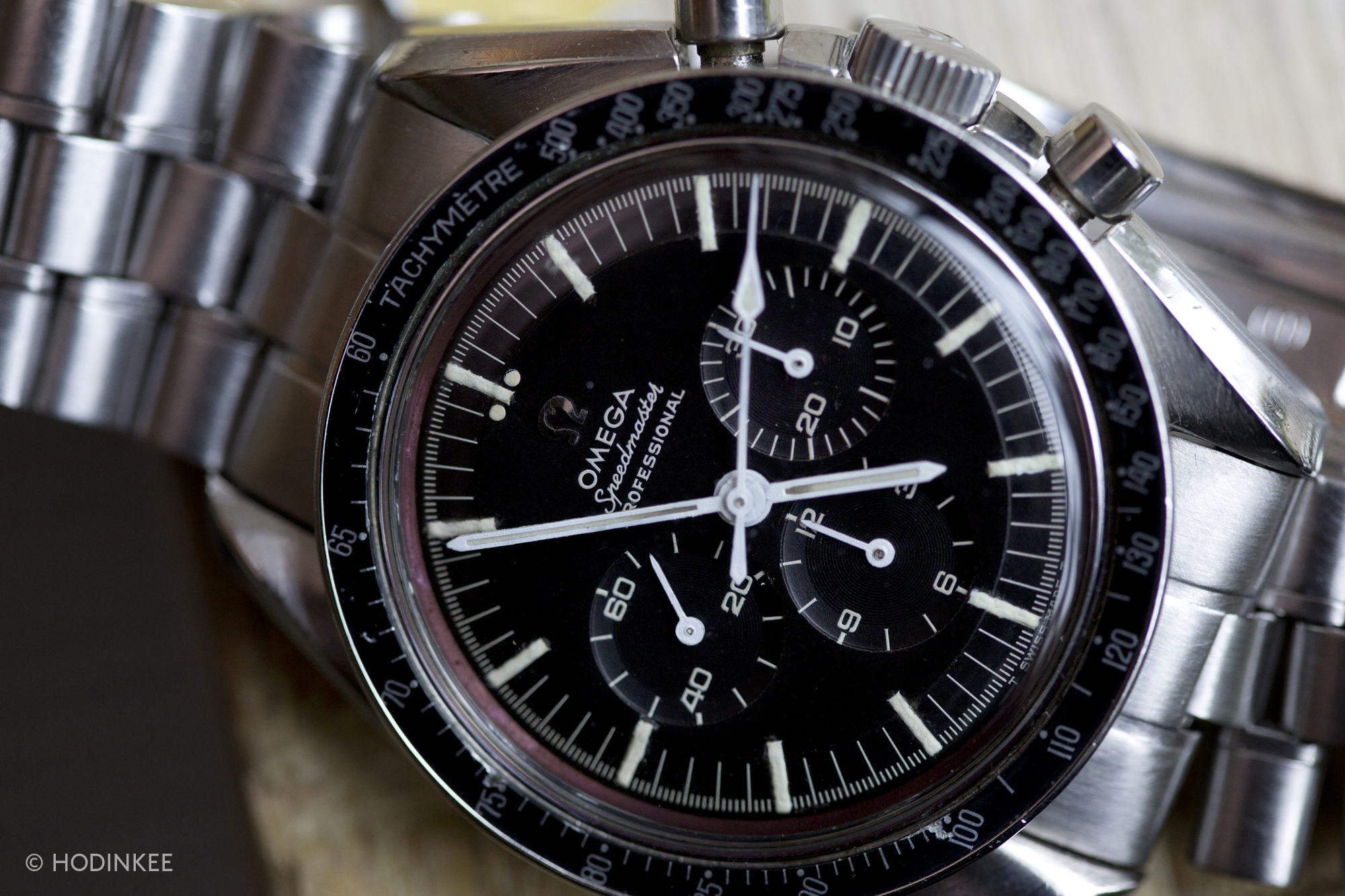
- —The 105.012 is the first asymmetric case, produced alongside the straight-lug 105.003, and it introduced the 'Professional' dial text; collectors often focus solely on this reference because of its wild variation in pushers (short/fat 'mushroom' vs service replacements) and dial T-mark configurations (none, close, or wide).
- —The original Speedmaster 2915 is so frequently assembled from parts and so hard to authenticate that the site's author says 'none of [the experts] work for an Auction House'—and as of 2019, at least three separate bezel forgery projects were underway to exploit its high values.
- —Opening the watch is non-negotiable: you must verify the calibre (copper-coloured 321 or 861), the eight-digit serial number, and the reference number inside the case back; the only safe tool is the Pahawi opener, purpose-built for Speedmasters to avoid slipping and damaging the case.
- —A 145.022-78 in excellent all-round condition with correct dial, hands, and bracelet typically sells between $5,500 and $7,500 between private collectors, but a similar watch with dial scarring, wrong hands, and no service can drop to $2,500.
Learn
From 2915 to Pre-Moon: the References That Matter
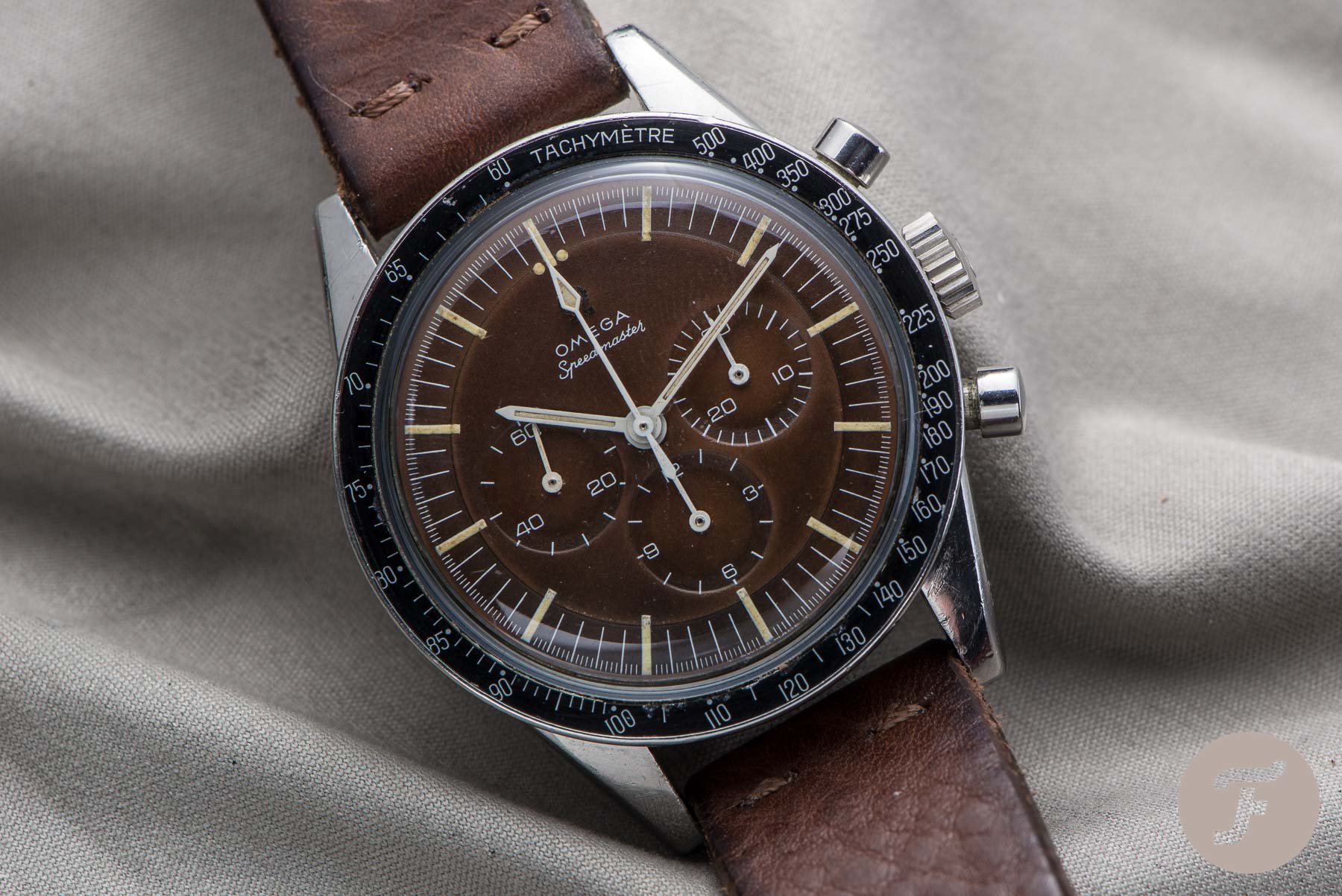
The vintage Omega Speedmaster story is really a chase through a handful of definitive references that define the pre-Moon era. It starts with the CK2915 (1957–1959), the very first Speedmaster and the first chronograph ever to put the tachymeter on the bezel instead of the dial — a breakthrough for readability. The CK2998 (1959–1963) followed, and it holds the curious distinction of being the first Speedmaster in space, not through NASA's official program but because astronauts Wally Schirra and Gordon Cooper bought them privately. The straight-lug 105.003 (1963–1969) is the 'Ed White' watch — the one worn during America's first spacewalk — and it introduced the baton hands that became iconic. Then came the first 'Professional' models, the 105.012 and 145.012 (1967–1969), which added crown guards, curved lugs, and the caliber 321 column-wheel movement that powered every Moon landing. Only three references — 105.003, 105.012, and 145.012 — actually touched the lunar surface; the later caliber 861 145.022 that people often call the Moonwatch was never there. The 145.012 was the last and most produced caliber 321 Speedmaster, making it the most accessible entry into this rarefied world, while the CK2915 saw only 3,000–4,000 examples and remains the holy grail. Collectors obsess over details like ghost bezels, DON (Dot Over Ninety) bezel inserts, Alpha versus baton hands, and the JB Champion bracelets that NASA astronauts favored because they could snap off in an emergency.
 fratellowatches.comfratellowatches.com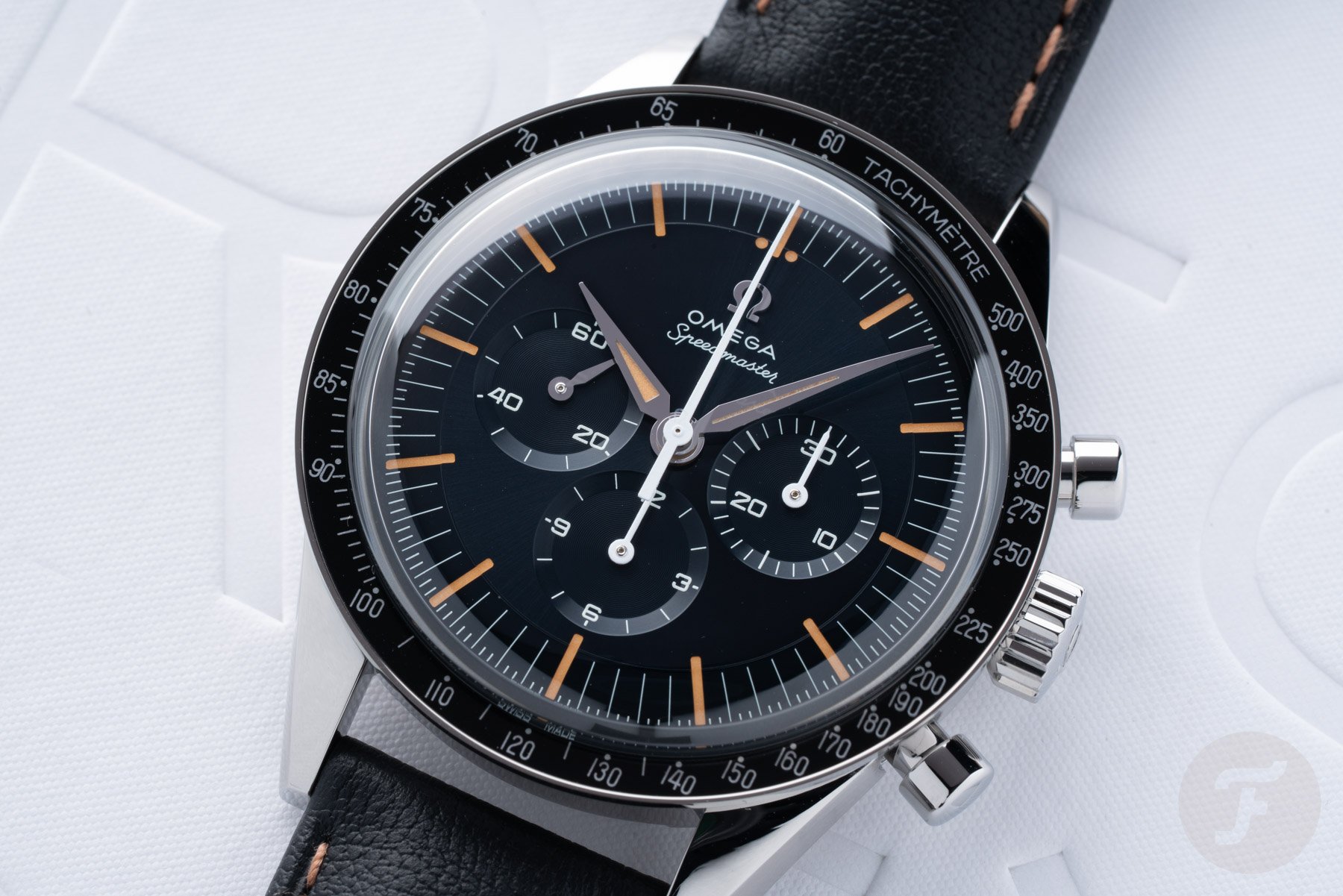
 watchfid.comwatchfid.com
+Field notes
- —The CK2915 (1957–1959) was the first chronograph to place the tachymeter scale on the bezel rather than the dial, a design change that made it far more legible for timing at speed.
- —Astronauts Wally Schirra and Gordon Cooper flew the CK2998 in space in 1962—years before NASA's official selection—simply because they bought their own watches privately.
- —The 105.003, nicknamed 'Ed White,' was the first Speedmaster used during a NASA spacewalk (Gemini IV, 1965) and originally came with Alpha hands before switching to the more familiar baton hands.
- —Only three Speedmaster references—105.003, 105.012, and 145.012—have actually been worn on the Moon; the later caliber 861 145.022 Speedmaster Professional never made that trip.
- —The 145.012 was the last Speedmaster powered by the column-wheel caliber 321 movement and, at 27,000–28,000 pieces, it is the most plentiful pre-Moon reference—making it the logical entry point for collectors.
- —Total production of all caliber 321 Speedmasters is estimated at just 80,000–83,000 watches, with the earliest CK2915 accounting for only 3,000–4,000 examples.
Learn
Learn the Collector Vocabulary Before You Buy
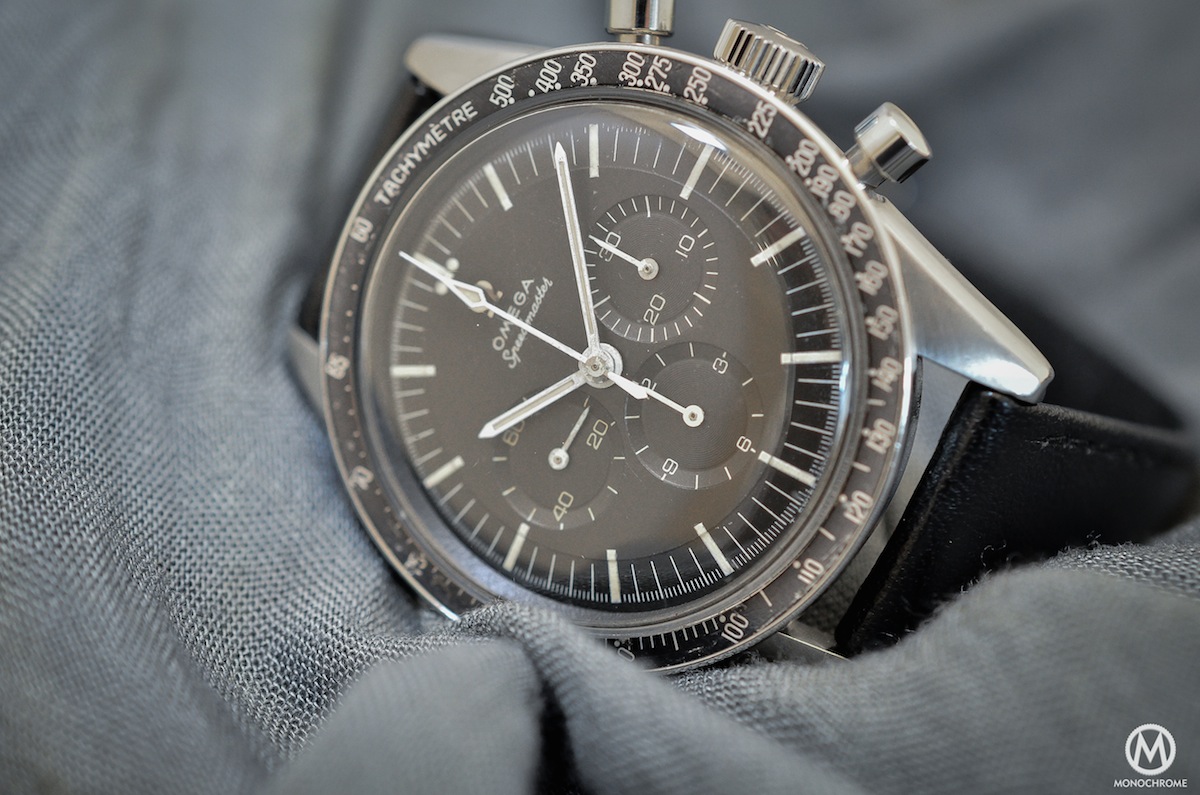
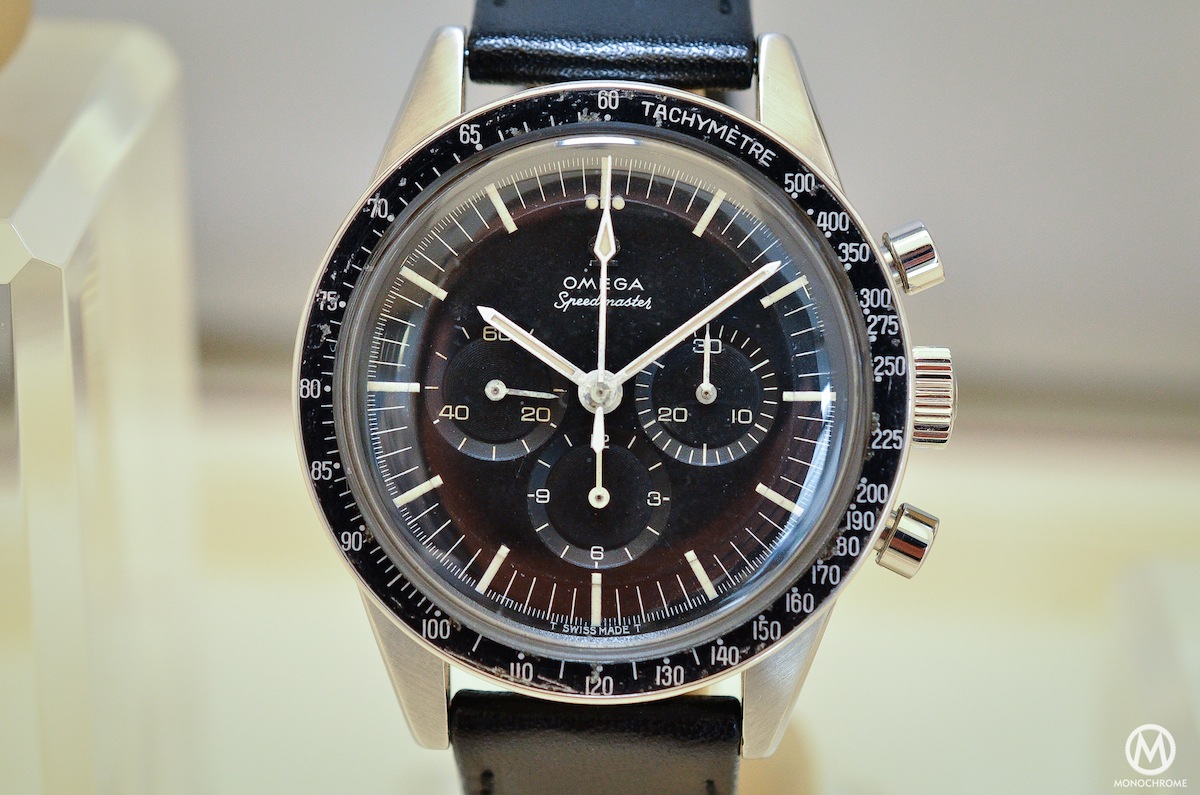
Before you buy a vintage Omega Speedmaster, you need to speak the collector's language, and the first word to learn is 'Ed White.' That's the nickname for reference 105.003, the last of the straight-lug Speedmasters, worn by astronaut Ed White during the first American spacewalk on Gemini 4 in 1965. Unlike later models, these are powered by the revered Calibre 321 column-wheel chronograph movement, and their values swing wildly based on condition: a pristine example with box and papers can fetch nearly $30,000, while a beat-up 'basket case' missing a pusher might sell for as little as $4,500. The dial is the soul of the watch — look for a 'stepped' dial with an applied metal Omega logo, long hour indices, and closely spaced 'T SWISS MADE T' markings for tritium. A dial that has turned brown from sunlight exposure is called 'tropical' and is highly prized by collectors, often adding a premium. Beware of re-painted hands, incorrect blue-tinted bezels, and overly polished cases that blur the sharp lug lines that matter so much. Many watches on the market are 'restored' or sold by dealers with dubious provenance; the best examples stay in private collections. For a sensible entry into 321-powered watches, expect to spend $4,000–$7,000 for an asymmetric 'Moonwatch' like the 145.012 or 105.012, or go for an 861-powered 145.022 in excellent shape for around $3,000. The golden rule from experts: buy the best condition you can afford, not the cheapest example you can find.
 speedmaster101.comspeedmaster101.com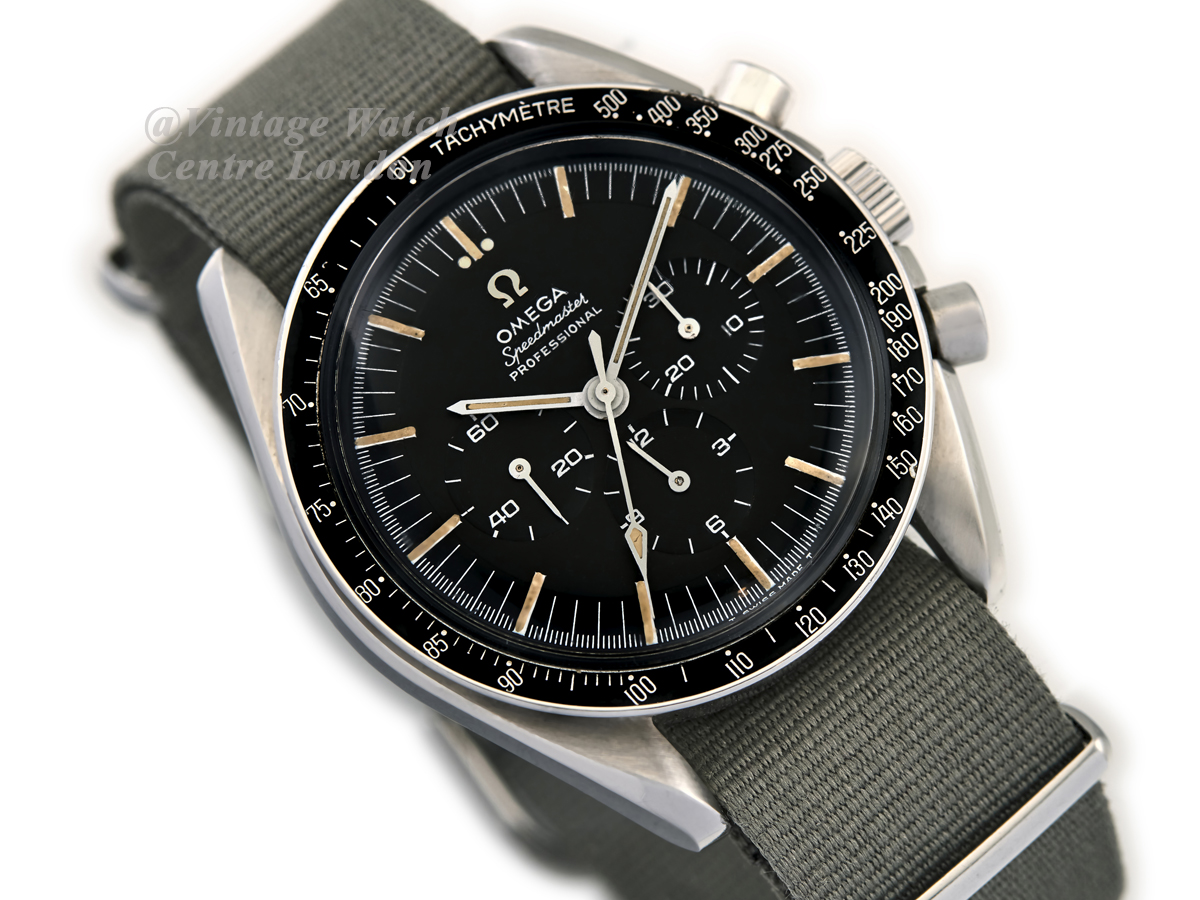
 lorologiese.comlorologiese.com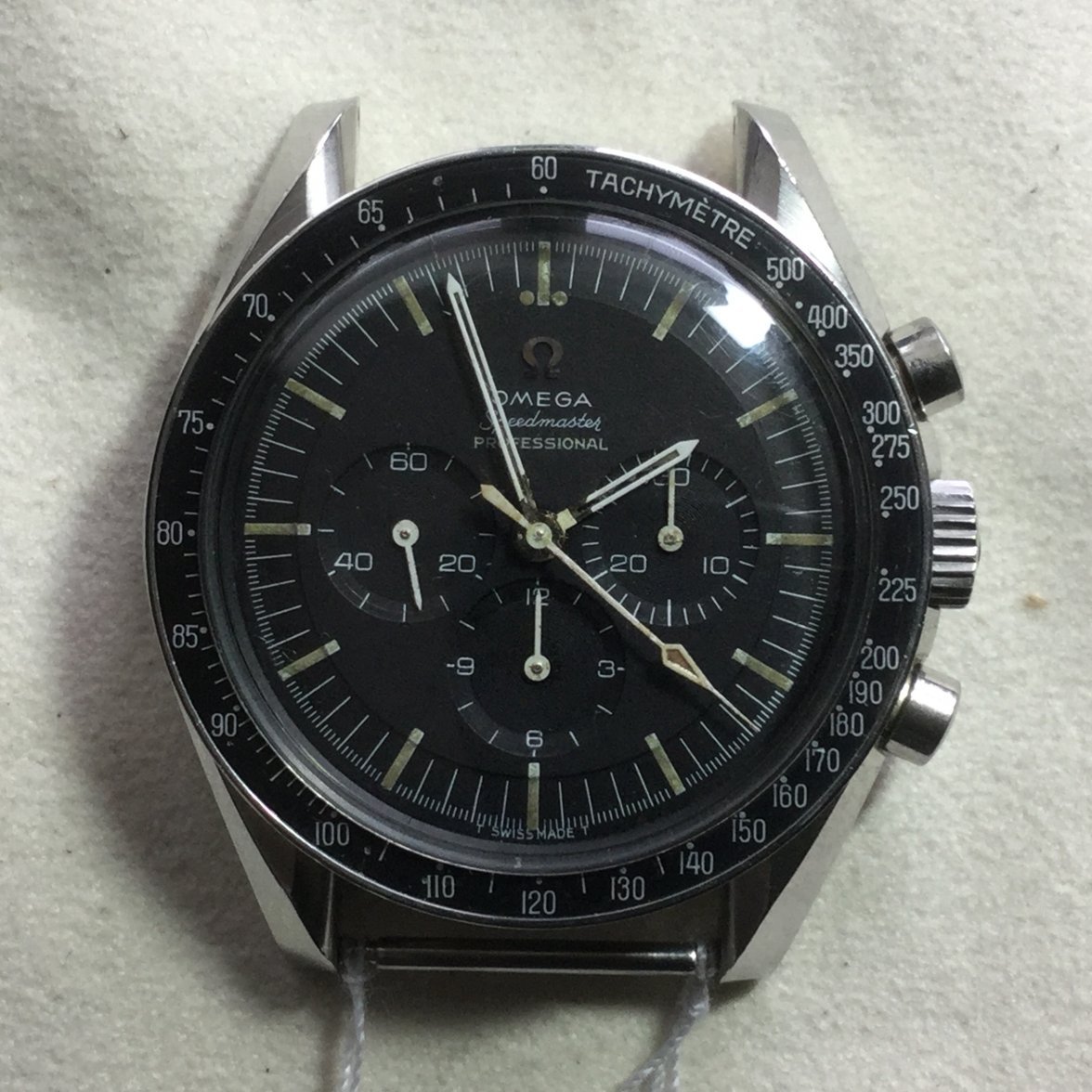
+Field notes
- —The reference 105.003 is called the 'Ed White' after the astronaut who wore it on the Gemini 4 spacewalk in 1965, and it is the last of the straight-lug Speedmaster cases — produced with case-back date stamps from -63 to -65, though examples were factory-released as late as 1969.
- —Values on the 105.003 vary enormously — a complete but worn example with a damaged dial and missing pusher sold for $4,500, while a sharp 'Excellent' example with box and papers can go for $22,000–$28,000, and a NOS (new old stock) could exceed $30,000.
- —A correct Ed White dial is always 'stepped' (a pronounced outer step), has an applied metal Omega logo (not printed), long hour indices, and 'T SWISS MADE T' with closely spaced T's — any dial without these features is likely a replacement or from a different reference.
- —A 'tropical' dial — where the original black has oxidized to a warm brown under UV and humidity — is a desirable natural aging effect, not a defect; a 105.003-65 with a tropical dial in excellent condition was listed at CHF 19,500 by a reputable dealer in 2024.
- —'Pre-Moon' refers to any Speedmaster with a smooth, acid-etched Hippocampus caseback (produced before 1969), while 'Moonwatch' means the caseback has the engraved commemorative text — the term refers to the engraving, not whether the watch actually went to space.
- —The Calibre 321 movement (column-wheel, hand-wound) is what collectors seek in early references; after around 1968, Omega switched to the cheaper cam-switch Calibre 861, found in references like 145.022, which can be bought in excellent shape for roughly $3,000 head-only.
Discover
Buyer’s Guides and Expert Breakdowns to Read Now
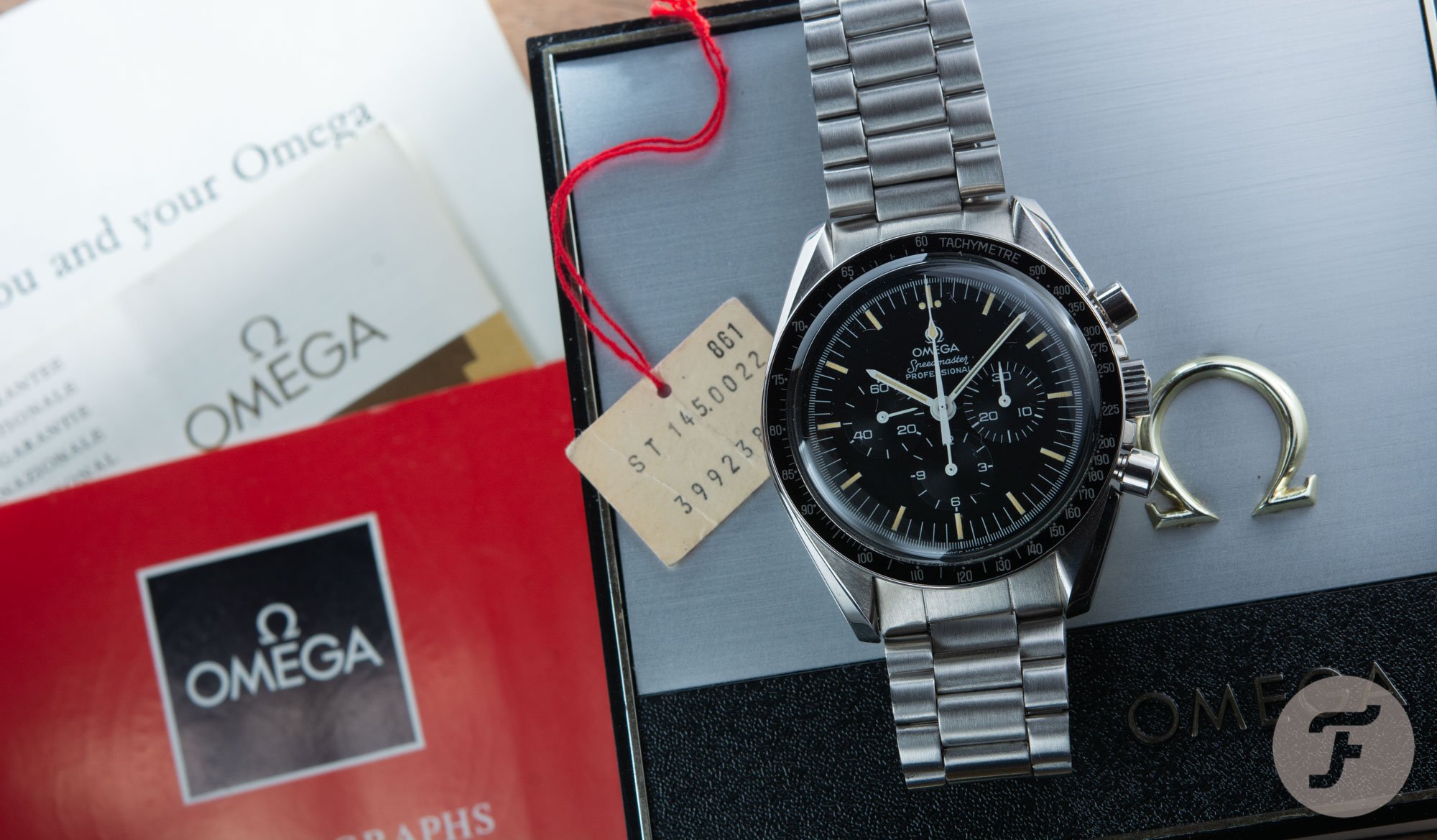
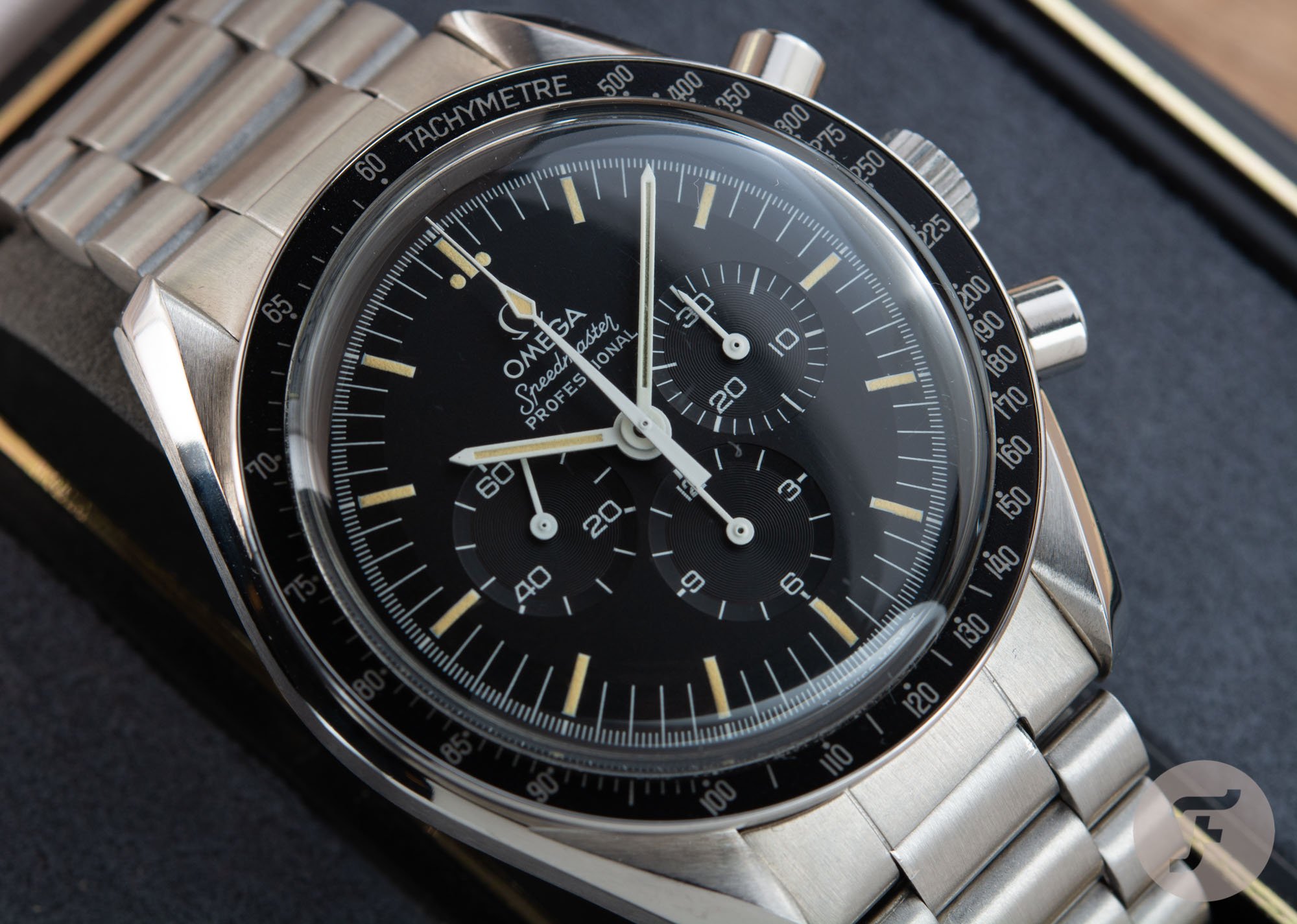
For the first time in years, a vintage Omega Speedmaster Professional from the 1970s can be had for roughly the same price—or less—than a brand-new Moonwatch, thanks to Omega's aggressive retail price hikes on the modern model. While the ultra-desirable caliber 321 pre-Moon references (like the 145.012) have climbed well past €10,000, the long-running caliber 861 reference 145.022 (1968–1988) remains the sweet spot: it's genuinely vintage, it came within a whisker of the Moon (astronaut Ron Evans wore one on Apollo 17), and it's still plentiful enough that you can find an untouched, all-original example if you're patient. The condition of the watch trumps everything—a mint 145.022 is a far better buy than a beat-up caliber 321 watch. Because the 145.022 was produced across twenty years with multiple subtle iterations (dial variations, case back engravings, bezel styles), a buyer's guide that breaks down those details is essential; Fratello's dedicated 145.022 buying guide and the Speedmaster101 resource are considered the gold standards for telling a correct watch from a frankenspeedy.
+Field notes
- —The 145.022 reference, powered by the caliber 861 (a Lemania-based shuttle-cam movement), was in production from 1968 to 1988 and offers the most accessible entry point into vintage Speedmaster ownership. It's the reference that Ron Evans wore on Apollo 17 for a heat-flow experiment, so it actually flew in space but never landed on the Moon.
- —As of early 2025, an average 1970s 145.022-69 on Chrono24 sits at about €7,495 — essentially 99.9% of the retail price of a new Moonwatch (€7,500). The vintage watch gained only 4.3% since 2021, while the new Moonwatch's RRP jumped 23%, making this the first time in years that a vintage Speedy is priced below the modern counterpart.
- —Caliber 321 Speedmasters (references 105.012, 145.012) now command five-figure prices even in so-so condition; Fratello's advice is to "rather over-spend on an excellent vintage Speedmaster" than buy a cheap caliber 321 that's been abused. A pristine caliber 861 watch is a better investment than a rough caliber 321.
- —The 145.012-67 was the last and most plentiful caliber 321 Speedmaster (27,000–28,000 pieces), making it the easiest pre-Moon watch to find. It was worn on the wrist of Apollo 11 astronaut Michael Collins, while Armstrong's and Aldrin's 105.012 references actually touched the lunar surface.
- —For identifying correct parts, the community relies on Speedmaster101 (run by collector William Roberts) and the historical work of Chuck Maddox, though Maddox's articles are now somewhat outdated. Fratello also recommends Roman Hartmann's serial number list as the most accurate reference for dating Speedmasters.
- —The total lockouts — even official dealers and watchmakers have swapped parts during servicing over the decades, so a watch with some non-original bits isn't necessarily a red flag. The key is knowing whether the replacement parts are period-correct; the so-called 'Transitional' Speedmaster, which mixed old and new components, is a classic example of how borderline cases exist.
Keep exploring
More of Vintage Omega Speedmaster
More to explore
In the same world.

Vintage Rolex Watches
Vintage Rolex collecting revolves around older references whose value is tied not just to the model name, but to origina…
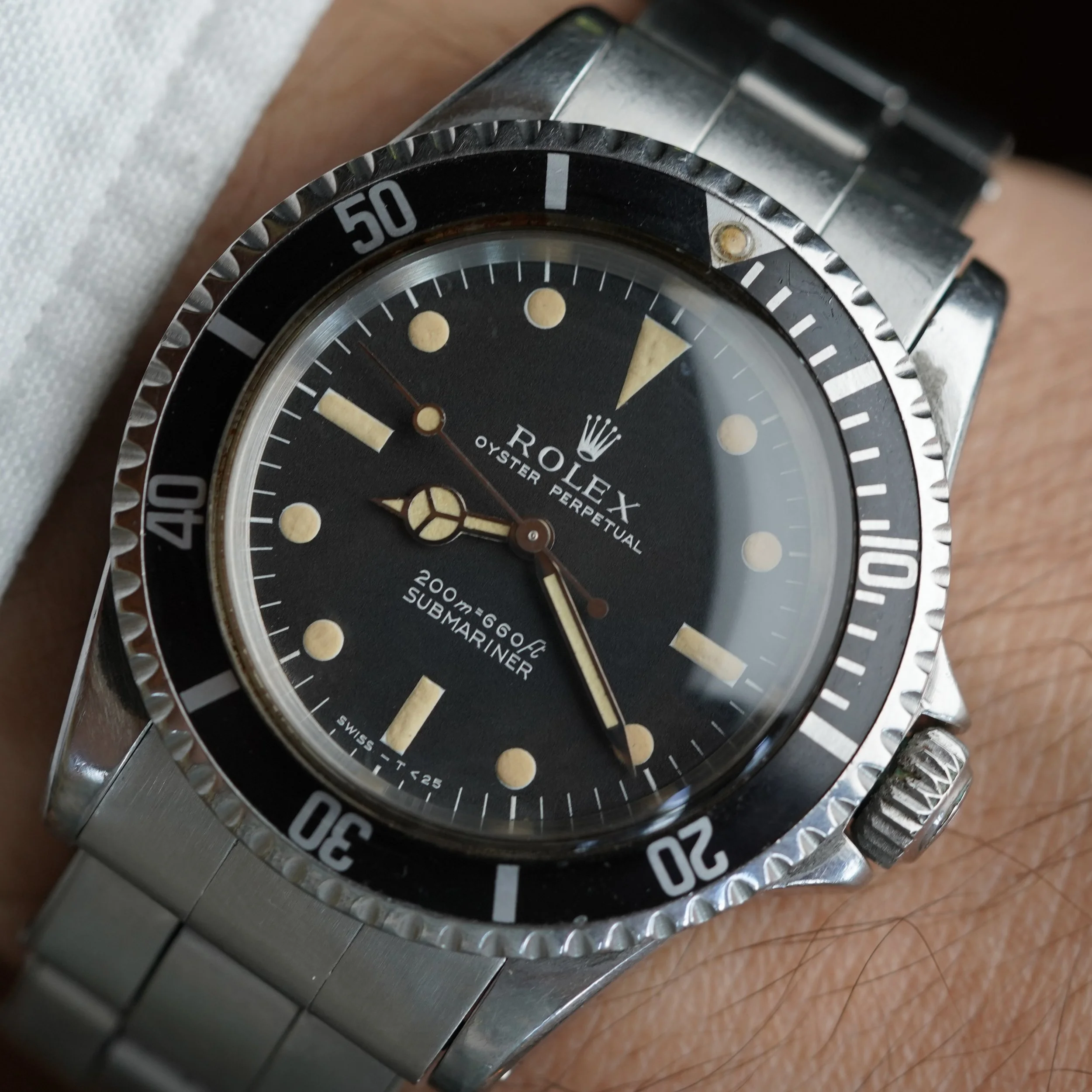
Vintage Rolex Submariner
When Rolex introduced the Submariner in 1953, it permanently defined what a dive watch could be — a purpose-built tool t…
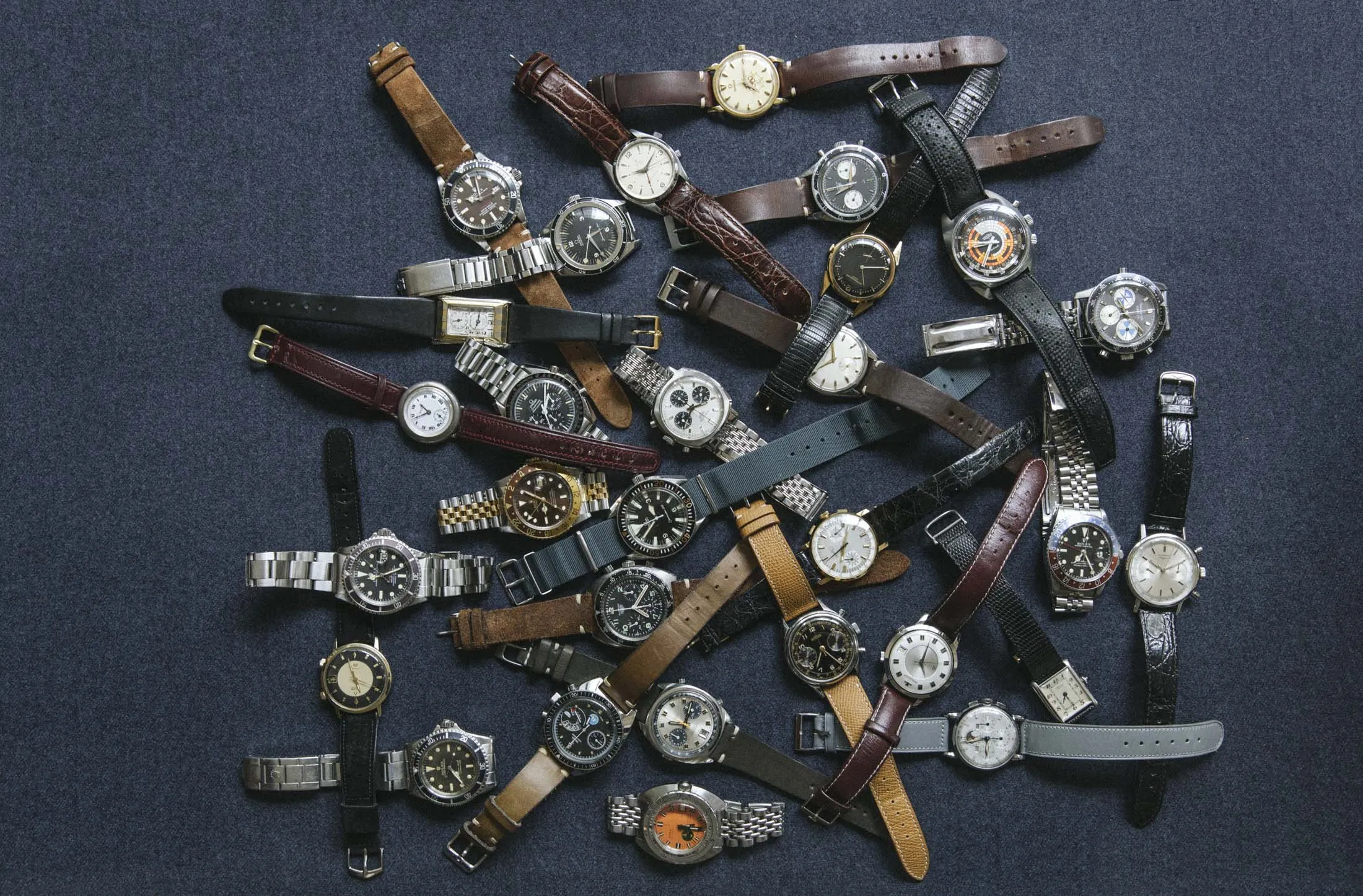
Vintage Watch Hunting
Vintage watch hunting is the search itself as much as the object: scanning eBay, dealer aggregators, flea markets, resal…
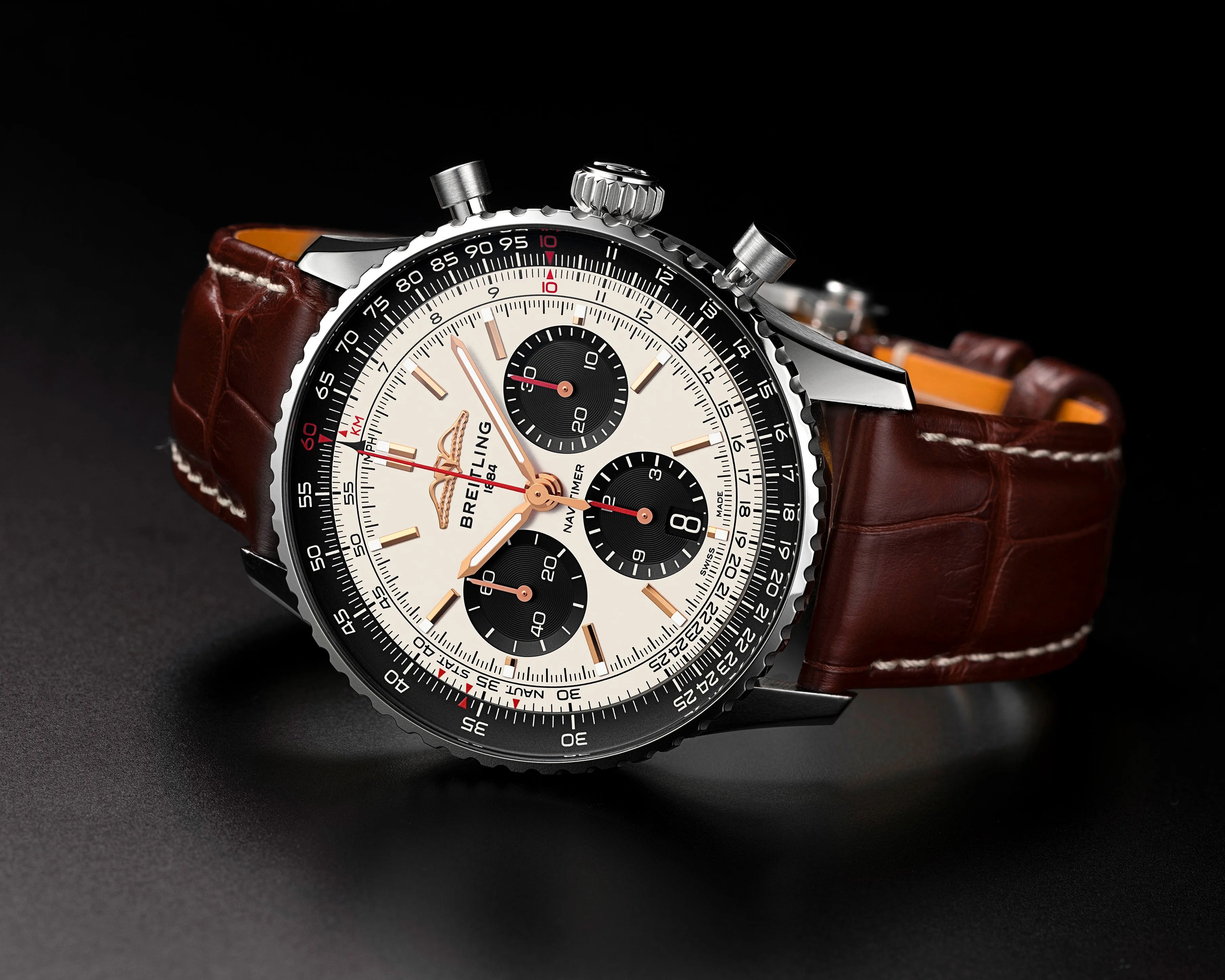
Breitling Navitimer
The Breitling Navitimer is a mechanical chronograph defined by aviation use and its signature circular slide rule, a fea…
Best First Luxury Watch
A first luxury watch is less about chasing a single “best” model than making a high-stakes first purchase with clear tra…

Piaget Reference 9801
Piaget reference 9801 appears in the market as a small 27mm manual-wind dress watch, often in 18k gold and frequently in…

Rolex Deepsea
The Rolex Deepsea is Rolex’s 44 mm extreme-depth dive watch, built around the brand’s Ringlock system and rated to 3,900…
Mechanical Watches
Mechanical watches run on a clockwork movement powered by a mainspring, with energy delivered through gears to a balance…
More in Watches & Horology
Stay in this world.
Grand Seiko SBGN001 9F GMT

Rolex Deepsea
Vintage Watch Hunting
Rolex Deepsea
Luxury Watches That Hold Value
Best Luxury Quartz Watches
Skeletonized Haute Horlogerie
Best First Luxury Watch
Imagery
Know someone who’d love this?
Discovered by ArcurianAuto-generated from public sources and AI synthesis — it may be incomplete or inaccurate. Treat it as a starting point for your own exploration, not professional (medical, legal, financial, or safety) advice. Verify anything you act on. Report this page.