
Piaget reference 9801 appears in the market as a small 27mm manual-wind dress watch, often in 18k gold and frequently in oval or ellipse-shaped cases from the 1970s. The listings and auction records around it point to the kinds of details Piaget collectors fixate on: ultra-thin 9P-family movements, hardstone dials such as malachite, lapis lazuli, blue coral, and tiger’s eye, and bark-textured or diamond-set executions that blur the line between watch and jewelry. Even within one reference, the mood can swing from a restrained gold classic to a white-gold bracelet watch with a gem-set stone dial. That variation is exactly what makes 9801 more interesting than a simple reference lookup—it opens onto Piaget’s stone-dial and high-jewelry world.
Learn
What Collectors Mean by Piaget 9801
Among vintage Piaget collectors, the reference 9801 is shorthand for the Maison's most virtuosic expression of 1970s stone-dial watchmaking, where the thin 9P1 caliber enabled wafer-thin cases that could house fragile semiprecious dials—lapis lazuli, tiger's eye, blue coral, or even solid bark-finished gold—without adding bulk. The reference appears in dozens of subtle variants (like 9801 D2, 9801 A 6, or 9801 D3), each denoting a specific dial material or diamond setting; connoisseurs prize the lapis lazuli and bark examples most, while the tiger's eye dial remains a relative sleeper, hammering for just €1,000 at auction. At 27mm wide and barely 5mm thick, these oval watches were marketed as unisex but fit more naturally on smaller wrists; the real obsession is not the case shape but the dial's texture and the hunt for original, unpolished stone surfaces with warm patina on the 18k gold.

 goldammer.megoldammer.me
 goldammer.megoldammer.me
 adams.ieadams.ie
 drouot.comdrouot.com
+Field notes
- —The 9801 consistently houses the Piaget Caliber 9P1, an ultra-thin manual-wind movement just 2mm tall, launched in 1957 as the thinnest wristwatch movement of its era with a 20.5mm diameter that allowed for larger cases than standard slim calibers.
- —Stone dials are the collector's obsession: documented examples include lapis lazuli, tiger's eye, blue coral, and 'bark-finished' 18k gold—each giving the watch a radically different personality, with lapis and bark considered the most desirable by specialists.
- —Auction results show dramatic price dispersion within the 9801 line: a tiger's eye dial sold for just €1,000 at Adams in 2024, while comparable lapis or bark examples from dealers routinely retail between $5,000 and $7,500, suggesting the market strongly favors textured stone over chatoyant gem varieties.
- —The 9801 was also produced in diamond-set configurations (variants 9801 D2 and 9801 A 6), with white gold cases and pavé diamond dials sometimes incorporating crescent-shaped lapis lazuli inserts—elevating the watch from stone-dial curiosity into High Jewelry territory, as seen in a Sotheby's lot estimated at HK$60,000–80,000.
- —Case dimensions are remarkably consistent across 9801 examples: 27mm wide (without crown), 29mm lug-to-lug, 11mm between lugs, and only 5mm thick, with a total weight of roughly 21 grams for a gold-cased watch—shockingly light due to the ultra-thin construction.
- —Collectors pay close attention to original dial condition: untouched 'never touched' stone dials with original hands and crown are heavily preferred, and the same listing that mentions 'warm patina' on the 18k case also notes that the original leather strap is often too deteriorated to wear, requiring immediate replacement.
Learn
The 1970s Piaget Stone-Dial and Jewelry-Watch Era
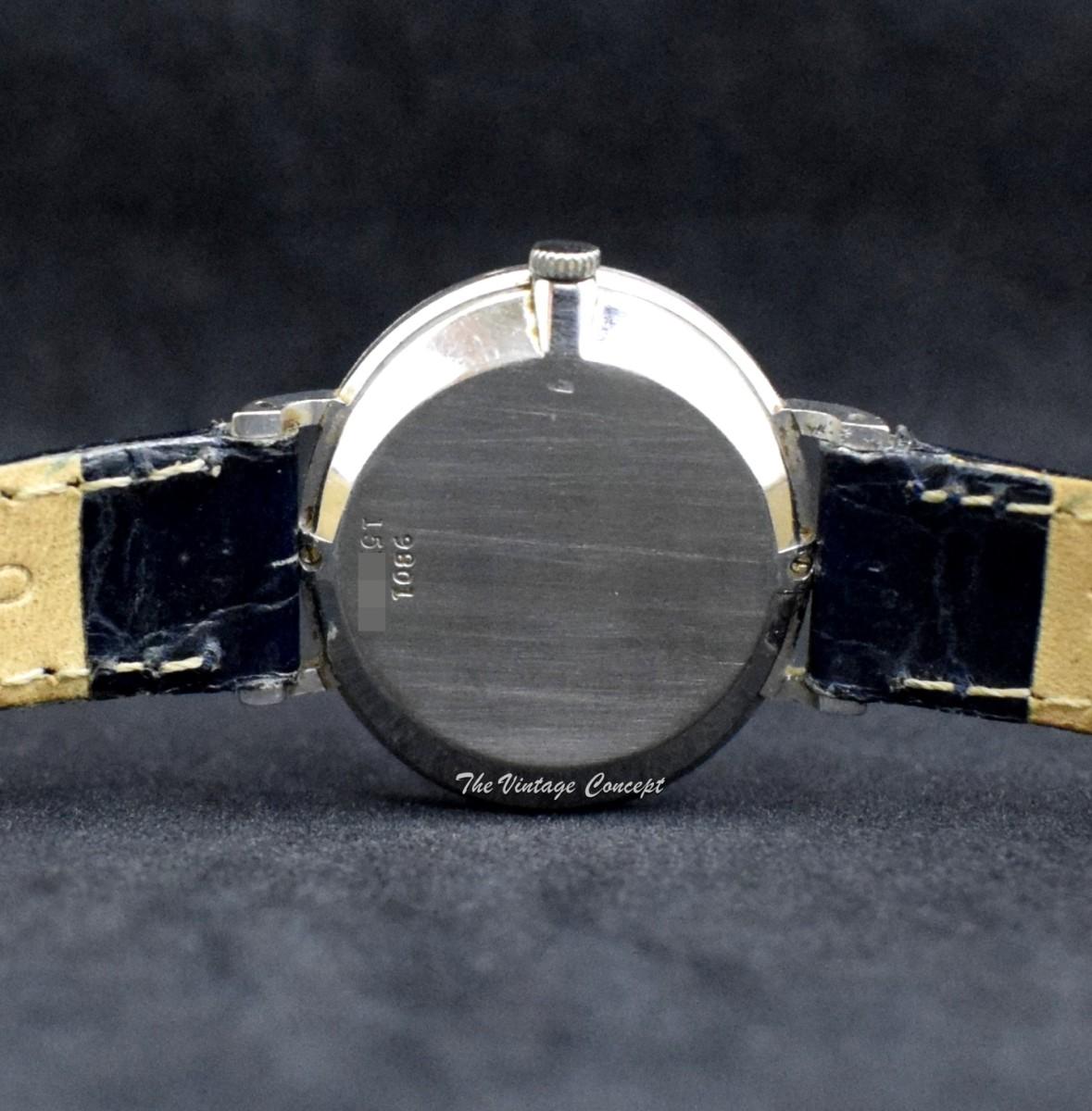
The 1970s were Piaget's golden era, when the brand transformed from a quiet movement manufacturer into a flamboyant jeweler-watchmaker that defined an entire decade's aesthetic. While others chased steel sports watches, Piaget went all-in on 18k gold cases, integrated bark-finish bracelets, and dials sliced from exotic hard stones like lapis lazuli, malachite, tiger's eye, onyx, and carnelian. These watches weren't just timepieces — they were sculptural jewelry, often designed as seamless cuffs or manchette bangles that wrapped the wrist in gold and stone. The movement powering them was usually Piaget's own ultra-thin caliber 9P, a manual-wind workhorse that let the case remain slim and elegant. Collectors today hunt these pieces for their unapologetic 1970s maximalism, with standout references like the hexagonal tiger's eye model, the cylindrical brick-set bracelet, and the dramatic Malachite dials that only a few brands ever mastered. The stone dials weren't decorative afterthoughts — they were the whole point, and Piaget's in-house studio elevated malachite, lapis, and nephrite into a wild, wearable art form.


 analogshift.comanalogshift.com
+Field notes
- —Piaget used roughly thirty ornamental hard stones — including lapis lazuli, malachite, onyx, carnelian, turquoise, tiger's eye, agate, and nephrite — as dial and bracelet materials, not merely as accents; the malachite craze among watchmakers started directly with Piaget in the late 1960s.
- —The signature 'bark finish' texture on Piaget's integrated gold bracelets was a design hallmark of the 1970s, giving a matte, organic feel to the metal that contrasted with the polished bezels and gleaming stone dials — seen on references like the 25mm lapis lazuli dress watch and the 23mm malachite white gold piece.
- —Piaget's ultra-thin manual-wind caliber 9P, an 18-jewel movement, was the engine behind most of these stone-dial creations, allowing cases as slim as 23mm and emphasizing the jewelry-like proportions rather than bulky sport-watch dimensions.
- —The 'Manchette' bangle watch (ref. 9467 D 59), launched around 1970, featured a cone-shaped gold openwork bracelet with a lapis lazuli dial — one example sold at Phillips in 2015 for CHF 81,250, far above its CHF 30,000–50,000 estimate, indicating the intense collector demand for these era-specific forms.
- —Piaget's large-format cylindrical bracelet watches, like ref. 9212 D 76, set alternating lapis lazuli and malachite 'bricks' into the 18k yellow gold links, turning the entire bracelet into a mosaic of hardstone — a construction so labor-intensive that it required perfectly matched stone slabs for each brick.
- —Hexagonal cases were a rarer shape in Piaget's stone-dial lineup; the 29mm x 22mm tiger's eye example, powered by the 9P caliber, shows how the geometric case design let the chatoyant brown-gold stripes of the stone catch light from multiple angles, making the dial the absolute centerpiece.
Learn
Read the Clues: 9P, Hardstone Dials, Bark Finish, and A-Suffix Cases
The Piaget Reference 9801 is a masterclass in 1970s design, pairing the ultra-thin manual-wind Caliber 9P (just 2 mm high) with audacious decorative treatments that made it a canvas for the brand's wildest creativity. Hardstone dials—like lapis lazuli cut into twin crescents or diamond-set malachite—turned each watch into a miniature gem, while the bark finish (a textured, tree-bark-like gold surface) covered both bezel and dial for a seamless, tactile statement. The A-suffix case variations (e.g., 9801 A 36) further distinguish these pieces, often in white gold with integrated bracelets. It's a watch that refuses to be subtle, and that's exactly the point.

 sothebys.comsothebys.com

 revolutionwatch.comrevolutionwatch.com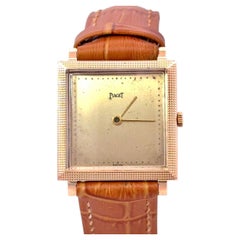
 reference.grail-watch.comreference.grail-watch.com
+Field notes
- —The Caliber 9P family (including the slightly thicker 9P2) measures just 2.0–2.15 mm thick, a 1957 breakthrough that let Piaget create ultra-slim dress watches like the Ref. 9801, often as thin as 5 mm including the case.
- —Hardstone dials were a Piaget specialty: the Ref. 9801 A 6 used two crescent-shaped lapis lazuli cuttings framing a pave-set diamond center, a feat of stone-cutting that few could match.
- —The bark finish—a textured gold surface resembling tree bark—was applied not just to the case but also to the dial of certain 9801 models, creating a fully integrated, monochrome look that was quintessentially 1970s.
- —The 'A' suffix in the reference (e.g., 9801 A 36) indicates a specific case/bracelet configuration, often paired with diamond-set hardstone dials or integrated bracelets; these details are key for collectors identifying rarer variants.
- —Despite its thinness, the 9P movement is fully jeweled (18 jewels) and features Incabloc shock protection, with later 9P2 versions using a Greiner-type collet and micro-metric screw for improved regulation.
Discover
Read Auction Catalogs and Dealer Descriptions Like a Buyer
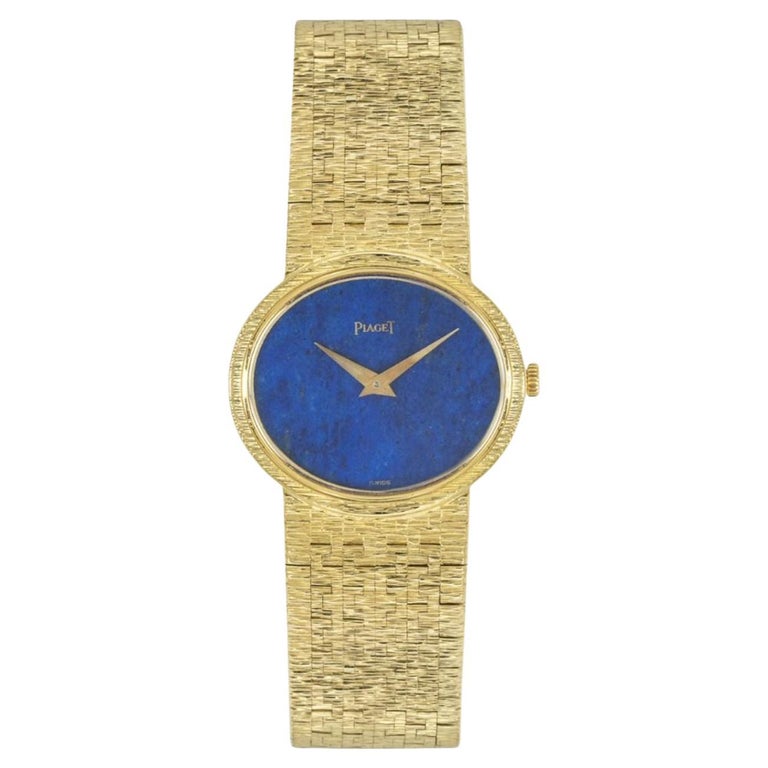
The Piaget Reference 9801, produced primarily in the 1970s, is a quintessential example of the maison's expertise in integrating precious hardstone dials into elegant oval cases. As a buyer, reading auction and dealer listings for this reference demands attention to specific identifiers: case numbers (e.g., 266'727 for a lapis example, 323'148 for malachite), movement numbers (like the cal. 9P2's 7'807'528), and the exact dial material—lapis lazuli, malachite, or tiger's eye—which dramatically affects value. Descriptions often emphasize the bracelet's 'bark finish' and the presence of diamond settings, with original box and papers being rare and thus significant. The manual-wind caliber, 27 mm typical diameter, and circa 1975 dating are consistent, but variations like white gold vs. yellow gold, and whether the dial is full lapis or set with diamond pavé, distinguish each piece. Condition reports scrutinizing the hardstone dial for cracks and the bracelet for stretch are critical. These catalogs reveal that while estimates vary from €1,000 for a tiger's eye example on leather to HKD 60,000–80,000 for a diamond-set lapis, the true connoisseur looks beyond price to the Maison's 'incredible imagination' in marrying semiprecious stones with haute horlogerie.
+Field notes
- —Case and movement numbers, such as case 266'727 and movement 7'807'528 for cal. 9P2, are essential for verifying authenticity and period—each ref. 9801 has unique serials that confirm its 1970s production.
- —Dial material is the single most important value driver: lapis lazuli, malachite, and tiger's eye each carry different rarity and price, with diamond-pavé dials (like the crescent-cut lapis) commanding higher estimates.
- —Original box and papers are rarely present (as seen in the malachite example—'Box: no; Papers: no'), and their absence is a typical condition that does not necessarily deter collectors but does lower potential value.
- —Bracelet style and material are key differentiators: the 'bark finish' gold bracelet with alternating hardstone panels (as in the Watch Centre example) is highly sought-after, whereas a leather strap (as in the tiger's eye example) suggests a less original configuration.
- —Size matters—case diameters range from 23mm to 28mm, with the typical oval's '27 x 29 mm with lugs' helping buyers distinguish this reference from smaller or larger Piaget models.
- —The manual-wind movement, often the caliber 9P2, is a thin workhorse; auction notes frequently highlight the 'mechanical, jeweled' specification, and the presence of the Piaget signature on case, dial, and movement confirms originality.
Keep exploring
More of Piaget Reference 9801


More to explore
In the same world.

Vintage Rolex Watches
Vintage Rolex collecting revolves around older references whose value is tied not just to the model name, but to origina…

Audemars Piguet Code 11.59
Code 11.59 is Audemars Piguet’s contemporary round-cased collection, revealed in 2019 as a platform for both new design…
Vintage Watch Hunting
Vintage watch hunting is the search itself as much as the object: scanning eBay, dealer aggregators, flea markets, resal…

Vintage Omega Speedmaster
Vintage Omega Speedmasters sit at the intersection of tool-watch history, lunar mythology, and exacting collector schola…

Audemars Piguet
Audemars Piguet is a Swiss luxury watchmaker rooted in Le Brassus in the Vallée de Joux, where the brand says its craft…

Blancpain Villeret
The Blancpain Villeret collection is the brand’s dress-watch center of gravity: restrained white dials, slim round cases…
Luxury Watches That Hold Value
In the watch world, “holding value” usually means a luxury piece that stays resilient on the secondary market rather tha…
Mechanical Watches
Mechanical watches run on a clockwork movement powered by a mainspring, with energy delivered through gears to a balance…
More in Watches & Horology
Stay in this world.
Grand Seiko SBGN001 9F GMT

Rolex Deepsea
Vintage Watch Hunting

Rolex Deepsea
Luxury Watches That Hold Value
Best Luxury Quartz Watches
Skeletonized Haute Horlogerie
Best First Luxury Watch
Know someone who’d love this?
Discovered by ArcurianAuto-generated from public sources and AI synthesis — it may be incomplete or inaccurate. Treat it as a starting point for your own exploration, not professional (medical, legal, financial, or safety) advice. Verify anything you act on. Report this page.